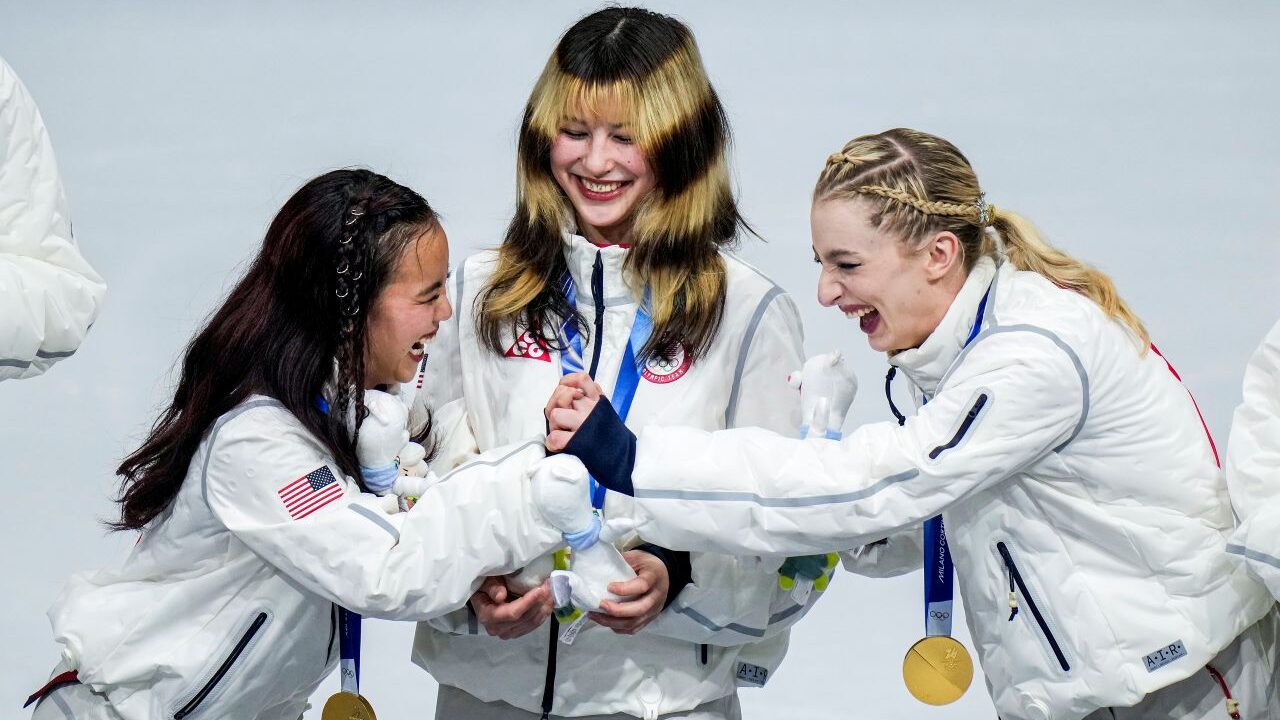
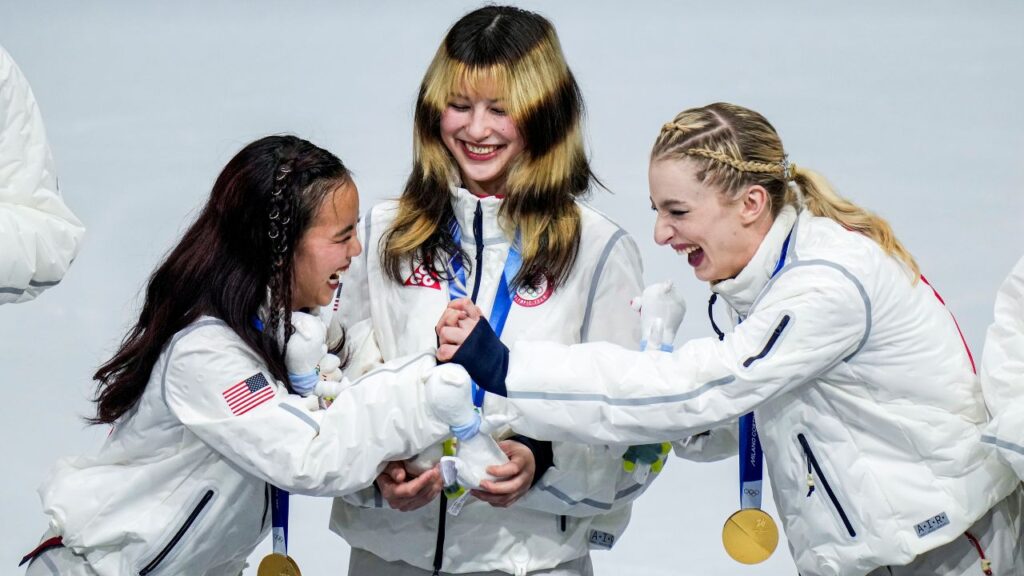
From left: Ellie Kam, Alysa Liu and Amber Glenn of the United States celebrate after their team won gold in the figure skating team event at the 2026 Milan Cortina Winter Olympics in Milan, Italy, on Sunday, Feb. 8, 2026. (Vincent Alban/The New York Times)

Share
|
Getting your Trinity Audio player ready...
|
MILAN — It’s easy to spot Alysa Liu.
At the Milan Cortina Olympics this week, during her group warmup for the figure skating short program, her competitors wore invisible blinders as they focused on their jumps and spins. Liu, however, looked as if she had arrived at a party.
She tried joking with her teammates. Waved to friends in the crowd. Applauded her fellow skaters.
At one point, she found her family in the stands — including her father, Arthur — and pointed at them, beaming as she flew by them on the ice.
Reigning World Champion
Liu, 20, the reigning world champion, enters the free skate Thursday at the Winter Games in third place overall, with a chance to win a medal at her second Olympics. But all will not be lost if she comes home empty-handed, she said, or even finishes last.
“That just doesn’t seem like a horrible situation,” she said. “I’d still be OK with that if that were a movie.”
The most important part of this Olympics, Liu said in the lead-up to the competition, is that she is the director of that movie. And the star, of course. But also the person in charge of casting and costumes.
Controlling her skating career after years of being told what to do — when to practice, what to eat, what to wear — was the only way she could return to the sport after a two-year break from it, she said. Her father would be the last to know.
“She came up to me in my office and said, ‘I have some very important news for you: I want to skate again,’” Arthur Liu, a lawyer, told The New York Times last month of their meeting in 2024. “And then she told me that I was not going to be involved at all, that I was no longer part of the team.”
Tearing up, he added, “I have to be honest with you, that hurt.”
Since then, he said, it has dawned on him: For Alysa to return to the sport, he had to let her go.
“I really couldn’t blame her for wanting to do her own thing,” said Arthur Liu, who came to the United States more than 35 years ago as a political refugee, having organized student protests in China during the Tiananmen Square military crackdown. “We’re both very free spirits.”
Youngest US National Champion
Alysa Liu was 13 when she became the youngest U.S. national champion in history, and then won a second national title the next year — all under the careful watch of a father who had started her in the sport at age 5. He had hopes that she would become the next champion skater, like Michelle Kwan, a Chinese American.
So he brought Alysa to all the best coaches. Spent $500,000 to $1 million. Did what he thought would nurture her natural talent.
He would sneak into the arena where she trained, just a few blocks from his law office in Oakland, California, with a list of jumps that she needed to land for the session to have been worthwhile. Triple axel? Check. (She was only 12 when she landed that jump, and was the youngest woman to land it in international competition.) Five triple lutzes? Check.
If the coaches didn’t meet his standards, he’d chastise them. Or fire them.
Phillip DiGuglielmo, Liu’s current coach, said Alysa’s father fired him three times — twice by text with the words, “I don’t need your services anymore.”
“I knew he was up there, hiding somewhere in the rafters, watching what we were doing,” DiGuglielmo said. “Afterward, he’d send me a text, saying Alysa’s talking too much — ‘Why are you talking and not skating?’ He wanted things to be done his way.”
Arthur Liu, who grew up so poor in a mountain village in China that his family would often struggle to have enough food, now says he was just being a good parent. During the pandemic, while he took care of his other four children as a single father, he arranged for Alysa to move to Delaware, Italy and Colorado, so she could continue training for the 2022 Beijing Games.
But she later said that she had never felt more disconnected or lonely, and her coaches noticed. The normally upbeat teenager would weep inside the hallway of the rink. Her skating lacked passion.
“The love for the sport, it just wasn’t there anymore,” said Drew Meekins, a choreographer who worked with her in Colorado.
Arthur Liu said he never knew how bad it was for Alysa. But just weeks after the Beijing Games, he found out.
Alysa Liu Quits the Sport
She quit the sport by posting a note about it on Instagram, saying, “i’m going to be moving on with my life.” She was just 16.
She skipped the usual post-Olympics series of skating shows, upsetting her father. Her social media accounts went dark — because she was off to find the light outside the sport: She enrolled at UCLA. Hung out with friends. Climbed to a Mount Everest base camp in Nepal. Took road trips. Had sleepovers. After all those years inside the rink, she finally felt free.
On a family skiing trip around early 2024, she said, she felt energized by the rush of speed as she whooshed down the mountain. Suddenly she realized that she missed the adrenaline she felt as a competitive skater, and decided to make a comeback, something unheard-of in the sport.
But this time, she would build her own team. She asked DiGuglielmo and choreographer Massimo Scali to guide her. She would have a say in her music and her competition dresses. The coaches, who were great examples of the newer, kinder generation of coaches, welcomed it.
“I remember taking her aside once and saying, ‘Alysa, I see you for who you are. You’re not just a world champion, or a product, and I’m with you on this journey,’” DiGuglielmo said.
That journey includes Alysa’s unique way of doing things. Before one big event last year, Scali saw her talking to a friend on FaceTime as she was warming up, and stopped himself from scolding her, thinking: “That’s usually a time to lock in, but we trust that she knows what she’s doing. She always delivers.”
He added, “Alysa is this beautiful, authentic Alysa and it’s different than we’ve ever seen. So pure and carefree. We respect her and follow her energy and guidance.”
Her father now understands.
“The last time should have been a wonderful, happy time for her at the Olympic Games, and I’m so sad that it wasn’t,” Arthur Liu said. But she is “making up for that now.”
—
This article originally appeared in The New York Times.
By Juliet Macur/Vincent Alban
c. 2026 The New York Times Company
RELATED TOPICS:
Categories




What to Know About the Trial of South Korea’s Ousted Leader
Alysa Liu Is Skating Again, Her Way This Time

West Virginia Sues Apple, Saying iCloud Distributed ‘Child Porn’