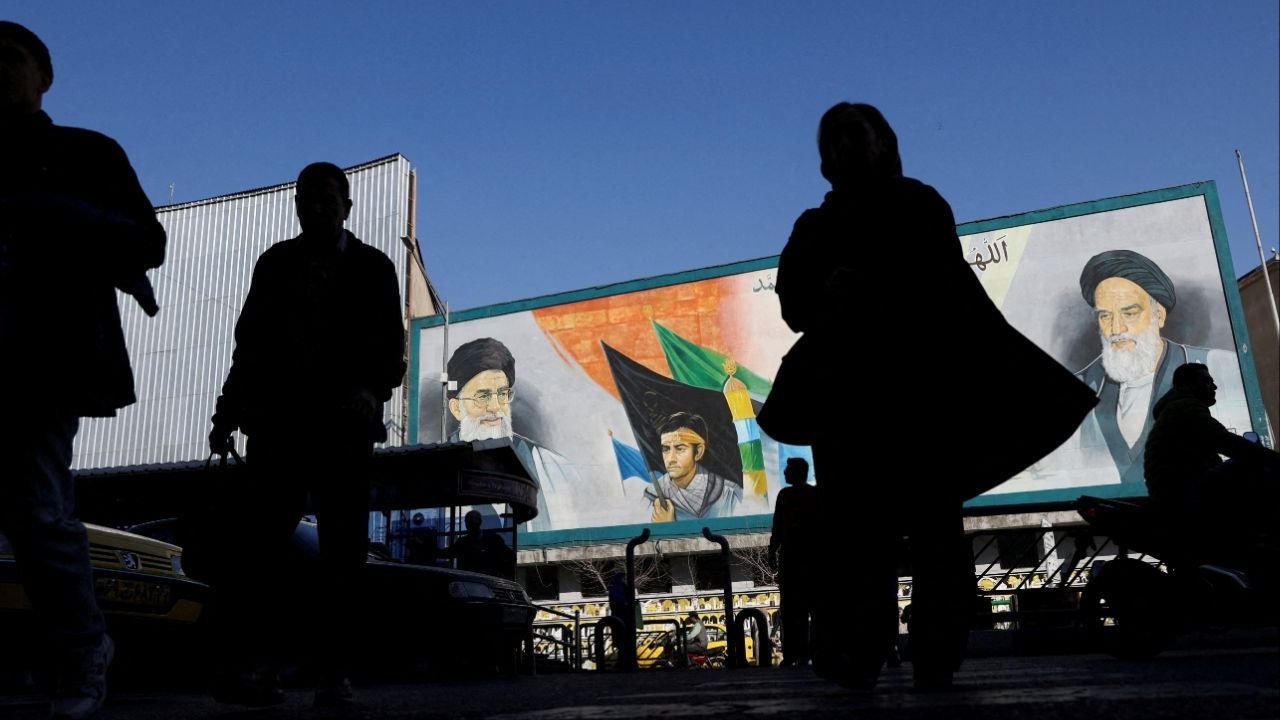
People walk near a mural featuring images of Iran's Supreme Leader Ayatollah Ali Khamenei and leader of Iran's 1979 Islamic Revolution Ayatollah Ruhollah Khomeini, on a street in Tehran, Iran, February 17, 2026. (Majid Asgaripour/WANA (West Asia News Agency) via Reuters)

Share
|
Getting your Trinity Audio player ready...
|
Iranians have returned to the streets this week to mourn those killed by security forces during last month’s anti-government demonstrations, sparking some new crackdowns in an echo of the 1979 Islamic Revolution that brought down the U.S.-backed Shah.
The anti-Shah revolutionaries turned Shi’ite Muslim memorial processions 40 days after each death into new protests, which prompted renewed violence from the authorities and fresh “martyrs” for the cause.
The clerical establishment’s opponents, deploying the same tactics after five decades, have yet to match the momentum of those times, but Iran’s clerical rulers, threatened with military attack by U.S. President Donald Trump over their nuclear and security policies, have demonstrated their concern.
They deployed security forces to some cemeteries and invited citizens to attend state-organized 40-day “Chehelom” ceremonies on Tuesday after apologizing to “all those affected” by violence they blamed on people described as “terrorists”.
“They tried to prevent history repeating itself by holding these ceremonies in mosques across the country. To prevent any gatherings of angry families in cemeteries, but they failed,” said one rights activist in Iran who declined to be named for fear of retribution.
Security Forces Clash With Mourners
Videos circulating on social media showed families holding their own memorials across Iran on Tuesday, 40 days after security forces began two days of widespread shooting that human rights groups say killed thousands of protesters.
Some of Tuesday’s memorials turned into wider anti-government protests and some were met with deadly force.
In the Kurdish town of Abdanan in Ilam province, witnesses and activists said security forces opened fire on hundreds of mourners gathered at a cemetery.
Videos showed people scattering as gunfire rang out amid chants of “Death to the dictator”, a reference to Iran’s Supreme Leader Ayatollah Ali Khamenei.
Reuters journalists verified that the videos were filmed at the cemetery. They were unable to verify the date but found no versions posted before Tuesday: eyewitnesses and activists said that was when people gathered at the cemetery were fired upon.
Hengaw, a Kurdish Iranian rights group, said at least three people were injured and nine arrested in Abdanan. Similar clashes were reported in Mashhad and Hamedan. Sources in Iran said internet access was heavily restricted in those cities.
Wednesday Is 40 Days Since Height of January Protests
More mourning ceremonies were expected to be taking place on Wednesday, 40 days since the deadliest two days of the January unrest, although communications restrictions meant that it was not immediately possible to tell how many or their outcome.
January’s unrest grew from modest economic protests in December among traders in Tehran’s Grand Bazaar into the gravest threat to Iran’s Shi’ite theocracy in nearly five decades, with protesters calling for ruling clerics to step down.
Authorities cut internet access, blaming “armed terrorists” linked to Israel and the United States for the violence, and have arrested journalists, lawyers, activists, human rights advocates and students, rights groups say.
Iranian officials have told Reuters the leadership is worried a U.S. strike could erode its grip on power by fueling more protests. Repression, inequality, corruption and the sponsorship of proxies abroad are the main grievances.
“How long can they kill people to stay in power? People are angry, people are frustrated,” said government employee Sara, 28, from the central city of Isfahan.
“The Islamic Republic has brought nothing but war, economic misery and death to my country”.
Trump has deployed aircraft carriers, fighter jets, guided-missile destroyers and other capabilities to the Middle East for a possible attack if talks to limit Iran’s nuclear program and weaken its foreign proxies do not yield results.
Even without a U.S. attack, continued isolation from Western sanctions would likely fuel further public anger.
In 1979, the anti-Shah revolt in provincial towns and villages was amplified by oil workers whose strikes cut most of Iran’s revenue, and bazaar merchants who funded the rebel clerics.
This time there have been no reports of either but people have adopted some of the small-scale tactics, chanting “Allah is great” and “Death to the dictator”, often from rooftops, during nightly demonstrations, according to witnesses and social media posts.
—
(Additional reporting by Catherine Cartier in Beirut, Sophie Royle Edward Carron in London, Fernando Robles, Monica Naime in Mexico; Writing by Parisa Hafezi; Editing by Philippa Fletcher)
RELATED TOPICS:
Categories

Fresno County Firefighters Free Puppy Stuck in Tire Wheel
Fresno Sues Homeowner Over Access to City-Owned Well
Meta Begins $65 Million Election Push to Advance AI Agenda
Trump to Host Board of Peace Meeting on Thursday, White House Says