

|
Getting your Trinity Audio player ready...
|
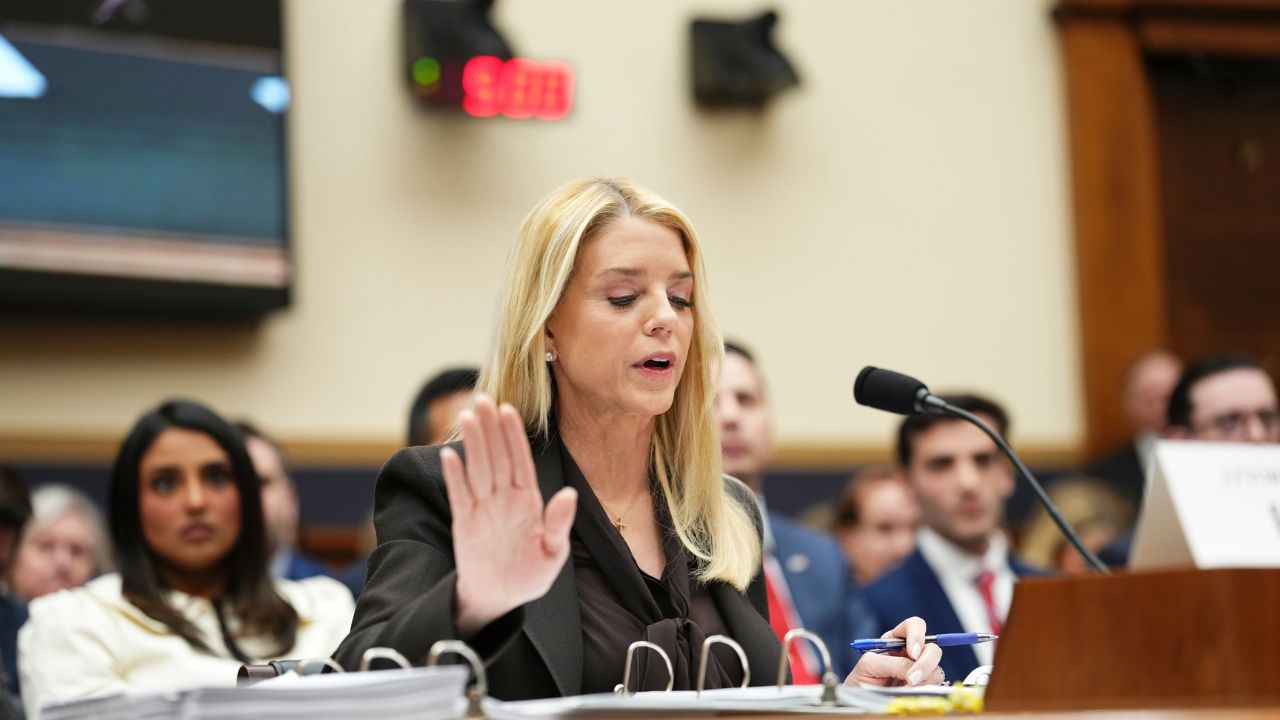
WASHINGTON — Attorney General Pam Bondi refused to apologize to survivors of convicted sex offender Jeffrey Epstein who were seated in the House Judiciary Committee room Wednesday — and instead demanded that Democrats apologize to President Donald Trump.
Bondi, imitating Trump’s tactic of going on the attack when facing tough questions, offered few detailed answers, no admissions of fault but many expressions of fealty and admiration for a president who has exercised direct control over her department’s actions.
The bitter back-and-forth, during a four-hour hearing before lawmakers, demonstrated the extent to which the Epstein files, once relegated to the conspiratorial outskirts of American politics, have become a defining issue for Bondi. The topic at times overshadowed her role in subordinating her department into an extension of Trump’s will and retribution agenda.

A Hearing Dominated by Epstein
While Bondi fielded questions on an array of controversies — including about the department’s unsuccessful effort a day earlier to prosecute six Democrats lawmakers who posted a video that enraged Trump — the focus almost always snapped back to the Epstein scandal.
Rep. Jamie Raskin, the top Democrat on the panel, delivered a salvo of disgust in his opening statement. He started by criticizing Bondi’s handling of the release of the investigative files involving Epstein.
“You’re siding with the perpetrators, and you’re ignoring the victims,” said Raskin, of Maryland. “That will be your legacy, unless you act quickly to change course. You’re running a massive Epstein cover-up right out of the Department of Justice.”
Bondi seemed unmoved. But she had a harder time evading the visuals in the hearing room, embodied by Epstein survivors who sat solemnly behind her in the gallery. She declined to apologize to them and only briefly cast eyes in their direction.
Confrontations and Counterattacks
A particularly uncomfortable moment came when Rep. Pramila Jayapal, a Washington Democrat, made an emotional appeal for Bondi to tell the women she was sorry for the slapdash, sluggish release of the Epstein documents, which inadvertently included the disclosure of victims’ names that were supposed to be redacted.
Bondi appeared momentarily at a loss for words. Then something clicked, and she began to counterattack, her voice swelling to a near shout, accusing Jayapal of “theatrics” and of dragging the hearing “into the gutter.”
She fiercely defended her actions in the Epstein case from the start, and placed blame for missed opportunities in the investigation on her Biden-era predecessors.
“I’m a career prosecutor,” she said during her opening remarks, adding, “I have spent my entire career fighting for victims, and will continue to do so.”
But she did not linger long on defense. Bondi taunted several of the committee’s Democrats, including Raskin and Rep. Jerrold Nadler of New York, for spearheading Trump’s impeachments.
“Have you apologized to President Trump?” asked Bondi, who has been eager to ingratiate herself to a White House that has been less than impressed by some of her actions, particularly on the Epstein matter.
“You sit here and you attack the president, and I am not going to have it,” added Bondi, who then pointed to the state of the stock market, eliciting derisive laughter from Democrats.
Political Fallout for Both Parties
The last time Bondi appeared before a congressional panel was in October, when she stonewalled Democrats for four hours and read from a list of scripted insults in response to their questioning of her conduct.
But Democrats, led by Raskin, prepared to counter that stall-and-brawl strategy, much to Bondi’s annoyance.
“We saw your performance in the Senate, and we’re not going to accept that,” Raskin said.
And he seemed to have an ally, at least procedurally, in the committee’s Republican chair, Rep. Jim Jordan of Ohio, who gingerly but firmly directed the agitated witness not to shout at or interrupt her questioners.
The Epstein case, once an obsessive focus of the right, has now become a powerful political weapon wielded by Democrats in attacking Trump and his appointees in the Justice Department and the FBI.
For Republicans, the never-ending Epstein fiasco has defined Bondi’s tenure in much the same way that her willingness to execute Trump’s commands has tarnished her in the eyes of Democrats.
The atmosphere was different — and chillier — than the one during her testimony before the Senate Judiciary Committee last fall, when Republicans rallied to Bondi’s defense in the face of withering questioning from Democrats.
Their defense of her Wednesday was notably muted, and instead of engaging directly with Democrats, many sought to steer the discussion away from Epstein and onto safer ground: the department’s efforts to combat street crime. Many of them simply ceded time reserved for questions to Bondi, allowing her to extend her criticisms of Democratic questioners.
One Republican critic of the Trump administration joined Democrats on the attack. Rep. Thomas Massie, R-Ky., has frequently criticized Bondi and her top deputy, Todd Blanche, over the handling of the files, accusing them of slow-walking or blocking the release of some material.
On Wednesday, Massie and Bondi clashed over the Justice Department’s inadvertent release of victims’ identities and the redactions of a purported co-conspirator’s identity.
“Who is responsible?” asked Massie, who helped write the law requiring the department to release the Epstein files. “Who in your organization made this massive failure?”
Bondi responded by accusing Massie of “Trump derangement syndrome,” and called him “a failed politician.”
There was, at least, one unexpected moment of bipartisan comity.
Rep. Eric Swalwell, D-Calif. — a frequent Trump critic — appealed to Bondi to investigate people who had made threats against him and his family.
“I’m just asking for your help to protect life, because life is at risk with the environment we’re in right now,” he said.
“They are being looked into,” Bondi replied. “None of you should be threatened, ever. None of your children should be threatened. None of your families should be threatened, and I will work with you.”
—
This article originally appeared in The New York Times.
By Glenn Thrush/Eric Lee
c.2026 The New York Times Company