
|
Getting your Trinity Audio player ready...
|
For nearly two years, Palestinians have been barred from returning to the Gaza Strip, watching in anguish as Israel’s bombing campaign against Hamas left whole neighborhoods in ruin and killed tens of thousands of people.
But late Monday, 12 residents were allowed back home after Israel and Egypt opened the Rafah border crossing, according to the Hamas-run Interior Ministry in Gaza.
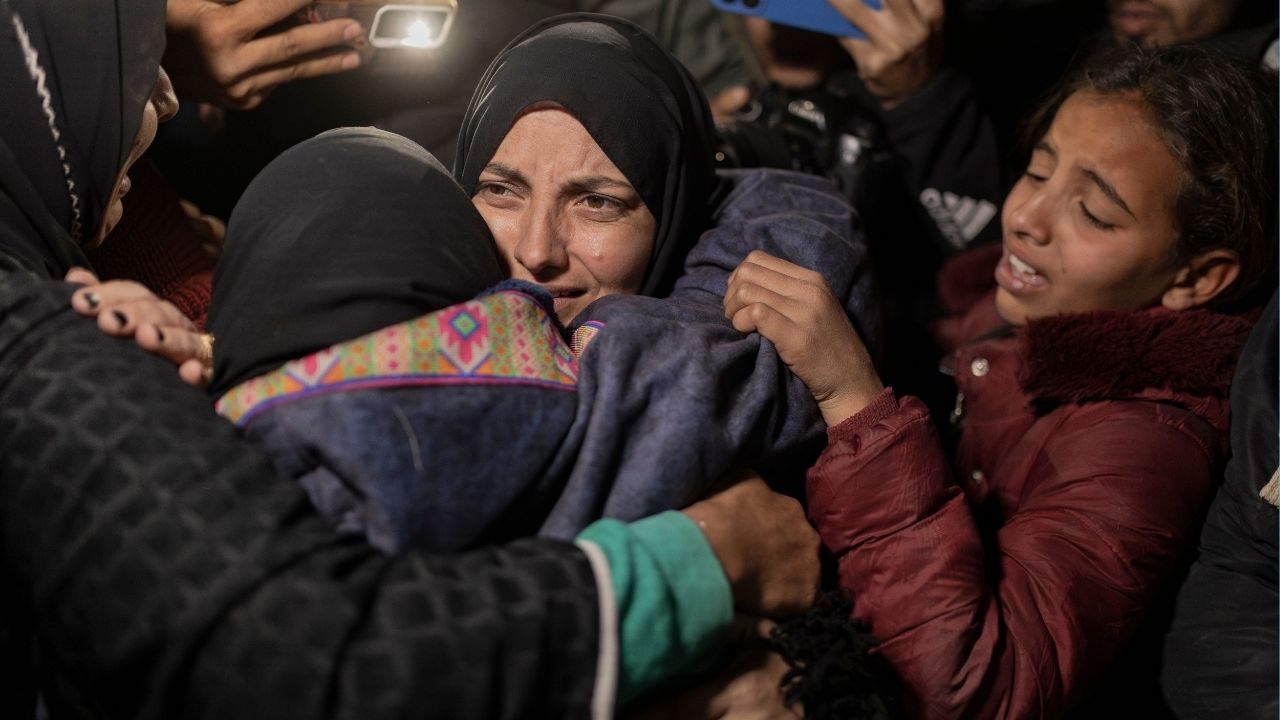
The small number of returnees reunited with their families. Coming home, several returnees said, was a rejection of any notions of permanently displacing them outside of the territory.

“No to expulsion,” said Huda Abu Abed, 56, who returned after leaving in March for medical treatment. “Nobody wants to leave their country.”
Uncertainty Loomed
For Palestinians who left Gaza during the two-year war, uncertainty has loomed over their return.
In February 2025, President Donald Trump proposed resettling Palestinians outside Gaza. But he unveiled a 20-point plan for ending the war in the territory in October that says “no one will be forced to leave.”
Still, right-wing members of the Israeli government have advocated for relocating Palestinians.
The opening of the Rafah crossing was part of a ceasefire agreement between Israel and Hamas in October. Israel had refused to open the crossing in both directions until all living hostages held by Hamas and all bodies of the deceased had been returned to Israel.
The last remains, those of Master Sgt. Ran Gvili, a member of the Israeli police, were recovered by Israel last week.
In the initial months of the war, the Rafah crossing was a lifeline for Palestinians trying to escape the war or seeking medical treatment abroad. But Israel took it over in May 2024 when its forces moved into Rafah, the southernmost city in Gaza.
For most of the 21 months since Israel took over, the crossing had been kept closed. The last time it temporarily opened was at the beginning of 2025, during a monthslong ceasefire.
On Monday, some ill Palestinians were allowed to leave Gaza through the Rafah crossing for treatment. Eight people left, including their caregivers, the Interior Ministry said.
About 20,000 people need to be evacuated for medical treatment, the Hamas-run Health Ministry in Gaza said last week.
Embassy Rounds up Returnees
Returnees told The New York Times that they had received phone calls from the Palestinian Embassy in Cairo on Sunday, telling them to gather at a meeting point in the Egyptian port city of El-Arish at 2 a.m. the next day.
The drive from El-Arish to the Rafah crossing is only about an hour. But the travelers did not reach their families waiting for them at Nasser Hospital in Khan Younis until 11 p.m.
Abu Abed, who was returning with her daughter, said she sat idly on the Egyptian side of the crossing for long hours before being transferred to the Gaza side. There, she was greeted by employees of the internationally-backed Palestinian Authority, which administers parts of the Israeli-occupied West Bank.
After her passport was stamped, European Union monitors confiscated some of her belongings, including a phone charger, she said.
Sabah al-Riqib, 41, who also returned to Gaza on Monday, shared a similar account, saying the monitors took away children’s toys. The EU Border Assistance Mission at the Rafah crossing did not immediately respond to a request for comment.
Abu Abed and al-Riqib said they then encountered members of a local Palestinian militia which rivals Hamas and is supported by Israel. The militia members searched their belongings and escorted them to Israeli security officers, who took their phones away for an hour and asked them whether their families were tied to Hamas.
“It was totally intrusive and exhausting,” Abu Abed said.
Israel has been supporting members of the militia, known as the Popular Forces, hoping they can undercut Hamas’ power over Gaza. The militia is based in southeastern Rafah and has been accused of looting aid trucks. Ghassan Duhine, the leader of the militia, did not respond to a request for comment.
Asked whether the Popular Forces were present at the crossing, an Israeli security official, who requested anonymity to discuss operational details, said “local Palestinians” were only involved in helping transport the returnees.
—
This article originally appeared in The New York Times.
By Adam Rasgon and Bilal Shbair/Saher Alghorra
c. 2026 The New York Times Company