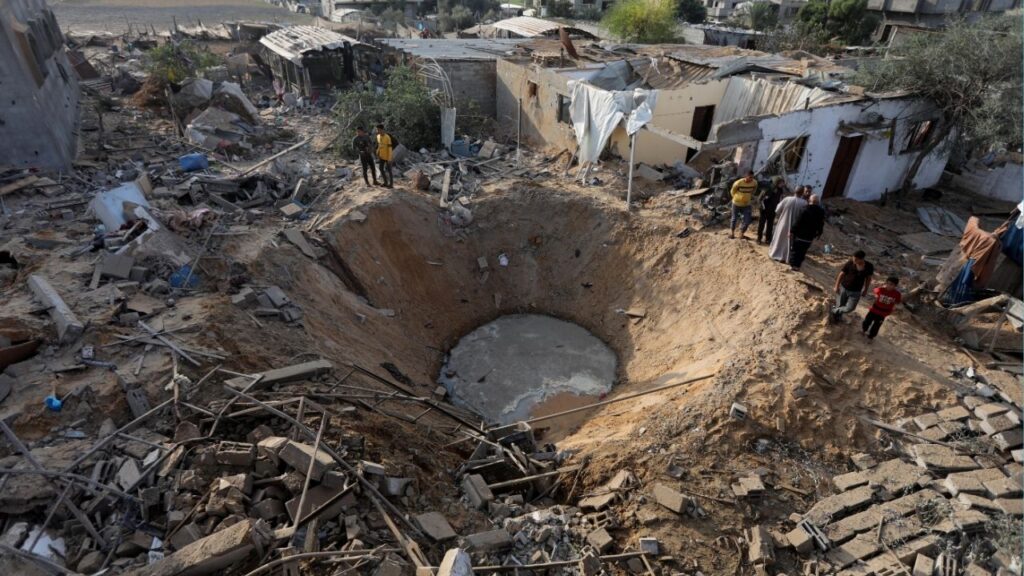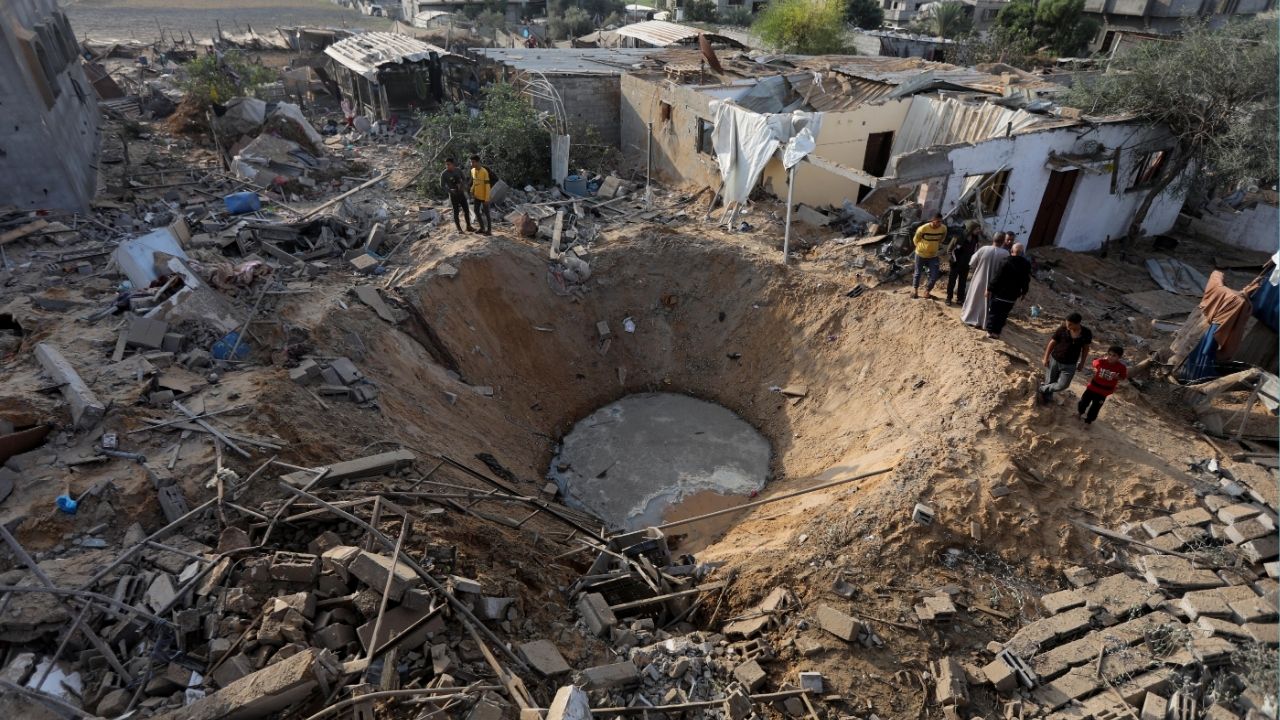
People gather around a bomb crater left by an Israeli airstrike in Khan Younis in Gaza on Wednesday, Oct. 11, 2023. In April 2024, Congress approved more than $14 billion in emergency military assistance to Israel. (Yousef Masoud/The New York Times)

Share
|
Getting your Trinity Audio player ready...
|
JERUSALEM — At the tail end of an hourlong news conference, Israeli Prime Minister Benjamin Netanyahu made a startling accusation. Israeli soldiers died during the war in the Gaza Strip because of a shortage of ammunition caused in part by the United States holding back some weapons deliveries.
While Netanyahu did not explicitly blame the Biden administration in his remarks Tuesday night, he implied it, saying that the situation had changed immeasurably since President Donald Trump took office a year ago.
“We paid very heavy prices in the war,” he said. “Part of it is just that’s what happens in war,” he added, but part of it was also because, “At a certain stage, we simply didn’t have enough ammunition and people fell, heroes fell.”
“Part of that shortage of ammunition was the result of an embargo,” he added.
The charge prompted a sharp rebuke from at least one former Middle East official in the Biden administration, Amos Hochstein.
“After more than $20 Billion military support” and “SAVING countless lives of Israelis,” he wrote in a social media post shortly after the news conference, the only acceptable response to President Joe Biden and the American people “is THANK YOU.”
Netanyahu leveled the accusation to lay out a bigger idea about phasing out Israeli dependency on billions of dollars annually in U.S. military aid — an idea that may curry him even more favor with Trump, who has been pushing allies to contribute more to their own defense.
Israel is preparing to begin negotiations on a memorandum of understanding with the United States for a multiyear package of military aid. The last 10-year package provided $38 billion, the largest of its kind. It was signed by the Obama administration in 2016 and is set to expire in 2028.
That deal phased out a special provision that previously allowed Israel, already the world’s leading recipient of U.S. military aid, to use about a quarter of the money to buy Israeli arms. Instead, it stipulated that it would have to use the American money to purchase American military systems, as other aid recipients are required to do.
The new negotiations are starting at a time when Americans’ support for Israel has been in decline, according to polls, with a majority opposed to sending additional aid to Israel because of the conduct of the war in Gaza and the high death toll.
Netanyahu said at the news conference Tuesday that Israel was forced to use artillery and airstrikes during the war because Hamas militants had holed up in booby-trapped buildings.
Although Republicans generally remain more supportive of Israel than many Democrats, according to those polls, some Republicans in Congress are keen to scale back military assistance to Israel. The Trump administration has already moved to cut billions of dollars in aid to multiple foreign countries in favor of “America First” initiatives.
Tapping into that theme, Netanyahu declared that Israel had “come of age” and that he intended to do away with the financial aspect of the United States’ military assistance to Israel within a decade. He said he wanted to see his country fund purchases itself and build up its own weapons industry.
Israel, Netanyahu said, needs to have a “robust” weapons industry to make the country as independent as possible and ensure it was not lacking in times of need.
He added that he wanted Israel’s relationship with the United States to move “from aid to partnership,” with symmetrical investments in, and joint production and manufacturing of, the most advanced weapons systems.
U.S. support for Israel’s security has been a cornerstone of the relationship between the two countries for decades, intertwined with shared strategic goals in the Middle East. To date, the United States has provided Israel with about $174 billion in bilateral assistance and missile defense funding, according to the U.S. government.
The Biden administration hardly scrimped when it came to helping Israel during the two-year war in Gaza. In April 2024, Congress approved more than $14 billion in emergency military assistance to Israel, including for air defense systems like Iron Dome. That was more than three times the amount the United States normally sends to Israel in a year.
The next month, however, the Biden administration paused an arms shipment of 3,500 heavy bombs amid a dispute over Israel’s plans for an assault on Rafah, Gaza’s southernmost city, where hundreds of thousands of displaced Palestinians were sheltering at the time.
Biden was worried about the mounting death toll in Gaza and had been pushing for a ceasefire. Netanyahu insisted on pressing ahead with the campaign against what he deemed another Hamas stronghold.
U.S. officials said in July 2024 that the administration would authorize part of the shipment and send 1,500 500-pound bombs to Israel, while continuing to withhold 1,800 2000-pound bombs. The Trump administration released the 2,000-pound bombs to Israel in January 2025.
Israeli experts say they are not sure what impact the delayed shipment had on the war, and there are differing opinions about the Biden administration’s decision.
Some critics of Netanyahu say that any lack of ammunition stemmed not from American actions, but mainly from the fact that Israel was surprised by the Hamas-led attack in 2023, which set off the war, and was woefully unprepared for what turned out to be a long conflict.
“In the end, he is ascribing the death of Israeli soldiers to something that could be attributed to the fact that the Israeli government did not have a clear policy for how to end the war,” said Jeremy Issacharoff, a former Israeli ambassador to Germany and an expert in arms control.
“Responsibility for the lives of Israeli soldiers lies with the government,” he said, adding that Netanyahu was “too quick to put the blame on others.”
Others in Israel saw Biden’s withholding of weapons as almost a betrayal, said Yaakov Amidror, a retired general who served as national security adviser under a previous Netanyahu government.
“It was perceived as something that is not done by friends. It created a terrible feeling, given the difficult situation Israel was in,” Amidror said, adding that Biden’s move had encouraged other countries to impose partial arms embargoes on Israel.
Amidror also said that he had no idea why Netanyahu had decided to raise the issue now. There is no connection, he added, between this and a decision to phase out U.S. military aid — an idea that Netanyahu has raised before, including in an interview with The Economist this month.
“Even if Israel doesn’t get a single dollar from America, Israel will continue to buy ammunition and a lot of other things there,” Amidror said, adding that phasing out aid was a “correct strategy.”
Issacharoff said that he was also in favor of having more of a partnership with the United States, as with Germany, where Israel both buys and sells weapons systems and the arrangement “works both ways.”
Israel can also provide the United States with valuable knowledge in return, such as intelligence or operational lessons, he noted.
But when it comes to Israel’s national security requirements and the idea of phasing out U.S. military assistance altogether, Issacharoff said that Israel first needed to assess very carefully what it required after two years of war.
“Making such announcements already, before entering into serious discussions with the Americans,” he said, “is at best incredibly premature.”
—
This article originally appeared in The New York Times.
By Isabel Kershner/Yousef Masoud
c. 2026 The New York Times Company
RELATED TOPICS:
Categories


A Democratic Critic of Newsom Will Run to Succeed Him