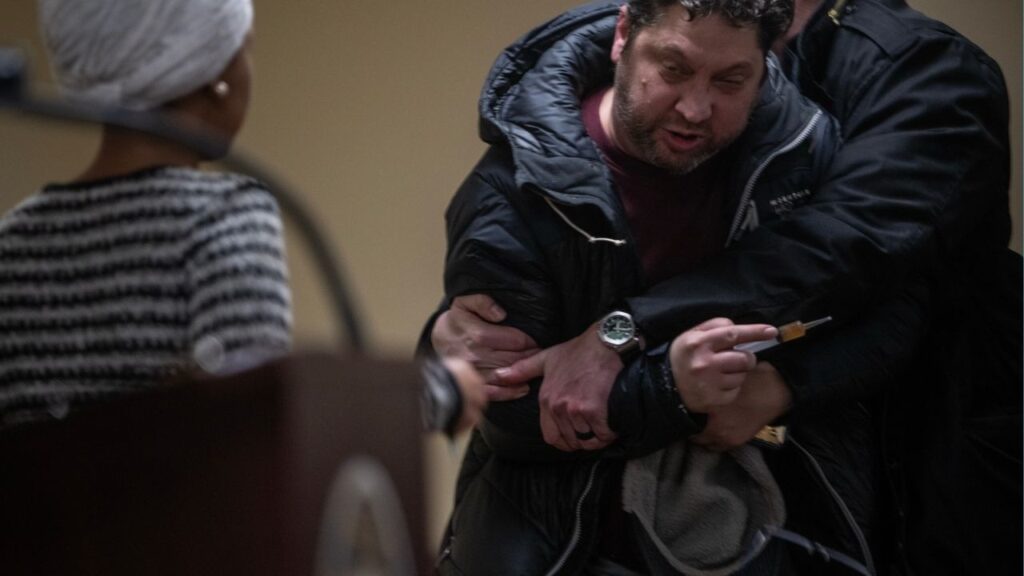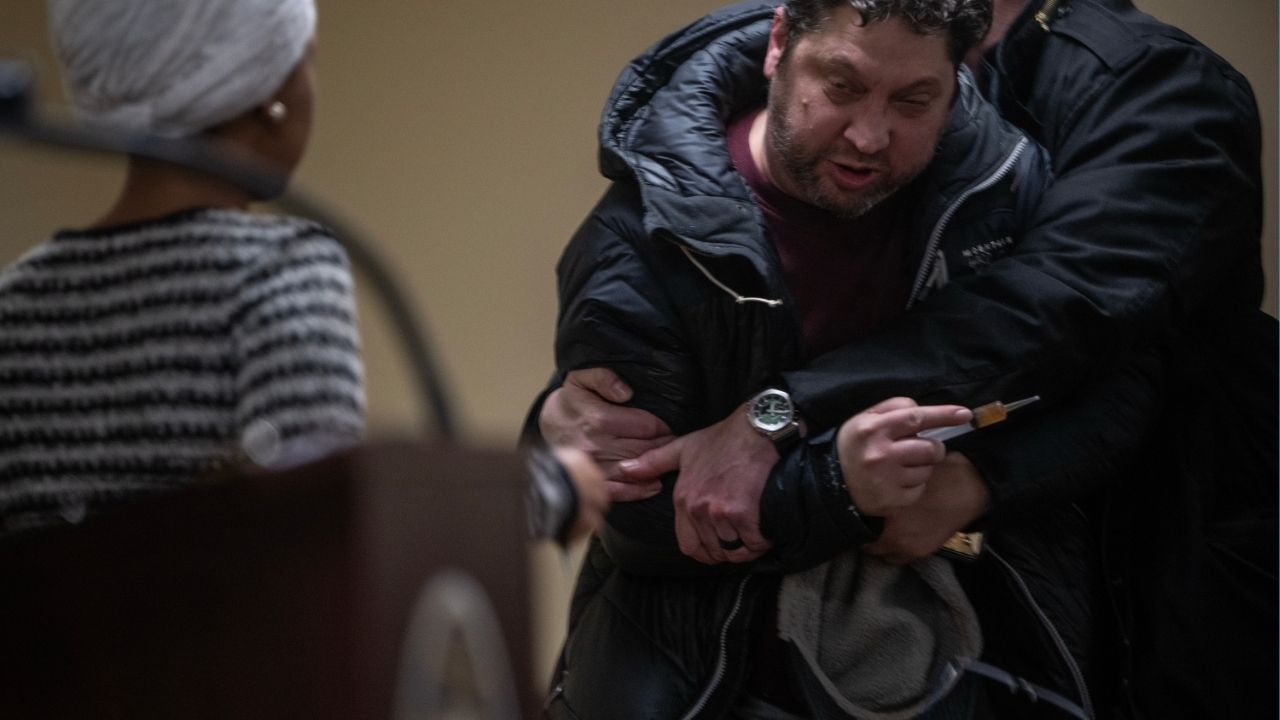
A man is held back after attacking Rep. Ilhan Omar (D-Minn.) during a town hall in Minneapolis, on Tuesday, Jan. 27, 2026. The man rushed the lectern and appeared to spray Omar with a strong-smelling liquid before he was tackled by security. Omar, visibly shaken after the assault, insisted to her staff and security that she would continue. (Victor J. Blue/The New York Times)

Share
|
Getting your Trinity Audio player ready...
|
Ilhan Omar, the Democratic member of Congress who was attacked at a public event in Minnesota on Tuesday, has come under fire for years, including from President Donald Trump.
“I’ve survived war. And I’m definitely going to survive intimidation and whatever these people think they can throw at me,” Omar said after the attack, in which the assailant sprayed her with an unknown substance. She appeared unharmed after the episode. A suspect, later identified by the police as Anthony J. Kazmierczak, 55, was arrested at the scene; his motives were unclear Wednesday.
Omar, who represents Minnesota’s 5th congressional district, has played an outsize role in national politics and has long been a target of right-wing criticism.
Trump has singled her out for years, frequently leading his supporters at rallies to chant “Send her back” to Somalia, where she was born. He has called Omar “garbage,” suggested without evidence that she married her brother and falsely said that she praised Islamist terrorist groups like al-Qaida.
Omar who was born in 1982, immigrated to the United States as a refugee at age 12.
She fled Somalia’s civil war for a refugee camp across the border in Kenya. In 1995, her family immigrated to the United States, living in Virginia before settling in Minneapolis, where many Somali immigrants have built a community.
In interviews, Omar, who wears a hijab, has described enduring bullying in school as a young, veiled recent arrival to the United States. Other kids, she said, stuck gum on her headscarf and knocked her down stairs.
Her father “sat me down, and he said, ‘Listen, these people who are doing all of these things to you, they’re not doing something to you because they dislike you,’” Omar said in a 2018 interview with The New York Times. “They are doing something to you because they feel threatened in some way by your existence.”
Omar went to North Dakota State University before returning to Minnesota, where she began climbing the ranks in Minneapolis politics. In 2017, she was elected to the state’s House of Representatives. Two years later, in 2019, she took office as one of the first two Muslim women elected to Congress, alongside Rep. Rashida Tlaib, D-Mich.
Omar arrived in Washington on a firmly progressive ticket — supporting LGBTQ+ rights and Medicare for All. She became part of a group of Democratic lawmakers firmly on the party’s left that included Rep. Alexandria Ocasio-Cortez of New York and was nicknamed “the Squad.”
Omar quickly became one of the most polarizing members of Congress, a household name for critics and supporters alike.
Some of her most contentious stances have been tied to Israel and the war in the Gaza Strip. Omar has long supported a movement to boycott Israel and accused its government of committing genocide in Gaza. Israel strongly denies the accusation.
Pro-Israel critics argued that some of her remarks crossed a line into antisemitism. In 2019, Omar wrote on social media that U.S. support for Israel was “all about the Benjamins” — referring to hundred-dollar bills. Some Jewish groups said the remark invoked anti-Jewish tropes involving money; Omar later apologized for the remark.
Omar’s supporters have argued that she has become a lightning rod for bad-faith critics who cannot abide seeing a Muslim woman in a head covering on the floor of Congress.
In recent weeks, House Republicans have threatened to open an investigation into Omar in an apparent effort to tie her to a Minnesota fraud scandal in which, law enforcement officials say, members of the Somali community billed state agencies for social services that were never provided.
Trump has used the scandal to broadly characterize Somali Americans, including Omar, as ingrates who should “go back to where they came from.” Many Somali Americans in Minnesota say the scandal has tarnished the reputation of their community of about 80,000 people.
Law enforcement officials have been looking into some of Omar’s finances as part of an investigation that began under the Biden administration. The New York Times reported this week that in 2024, the Justice Department began scrutinizing her finances, campaign spending and interactions with a foreign citizen.
No charges have been filed. Omar has denied wrongdoing, saying that “years of ‘investigations’ have found nothing.”
—
This article originally appeared in The New York Times.
By Aaron Boxerman/Victor J. Blue
c. 2026 The New York Times Company
RELATED TOPICS:
Categories