
|
Getting your Trinity Audio player ready...
|
President Donald Trump campaigned in 2024 on promises to “end inflation,” bring back manufacturing jobs and deliver an economic boom. A year after he returned to the White House, he has yet to deliver on those pledges. Still, there has been progress in some areas, and the economy has proved surprisingly resilient.
Here are eight of the promises Trump made as a candidate, and where things stand after his first year back in office.
—
Food Prices
Campaign rally in Pittsburgh, Nov. 4, 2024
“A vote for Trump means your groceries will be cheaper.”
Hasn’t Happened
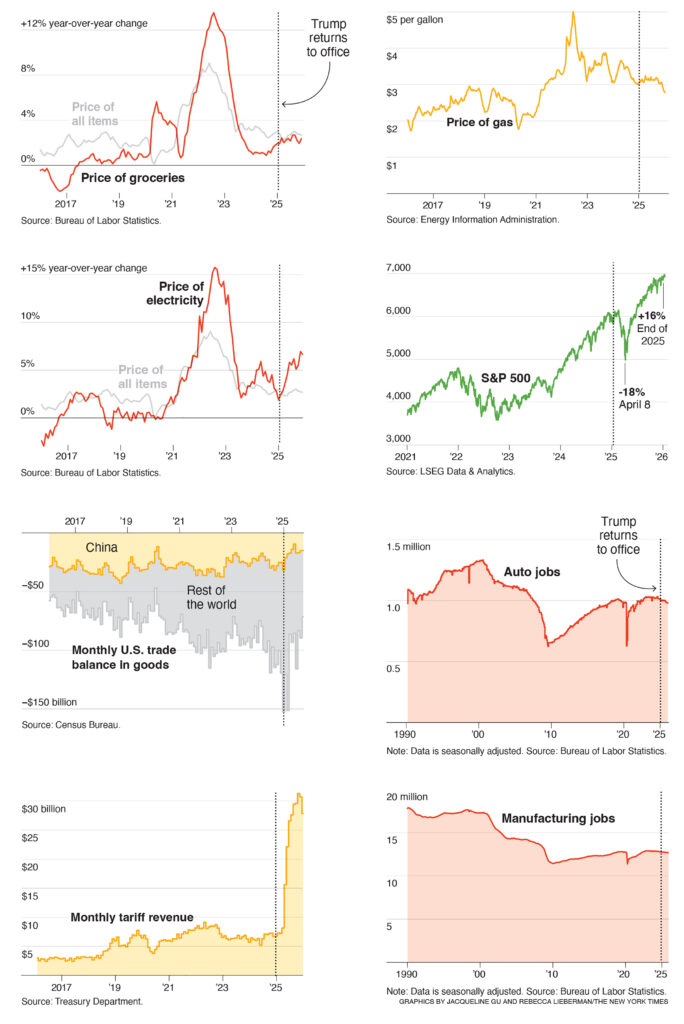
Prices are down for a few grocery categories, like eggs, but are up sharply in others, like beef. Overall, food inflation has slowed significantly since peaking in 2022, but it has picked up somewhat since Trump returned to office — December saw the biggest one-month increase in grocery prices since 2022.
He had promised to “bring down the prices of all goods.” Economists say that was never credible, but that inflation might have cooled more if he hadn’t imposed tariffs on many imports.
—
Gas Prices
Speech to Economic Club of New York, Sept. 5, 2024
“We’re going down and getting gasoline below $2 a gallon, bring down the price of everything from electricity rates to groceries.”
Some Progress
Gas prices have fallen under Trump, though not to the sub-$2 level he promised on the campaign trail. The average price of a gallon of regular gasoline was $2.78 in early January, according to the Energy Information Administration, down from just more than $3 a year earlier. Gas prices hit a record high of more than $5 a gallon in the wake of Russia’s invasion of Ukraine in 2022.
The factors driving the recent decline, including robust domestic oil production, were in place long before Trump’s return.
—
Electricity Prices
Campaign rally in Asheville, North Carolina, Aug. 14, 2024
“Under my leadership, the United States will commit to the ambitious goal of slashing energy and electricity prices by half, at least half. We intend to slash prices by half within 12 months, at a maximum 18 months.”
Hasn’t Happened
Unlike with gasoline, different parts of the country pay sharply different prices for electricity. On average, residential electricity prices in December were up 6.7% from a year earlier, and have risen far more in some areas.
Power prices are being driven in part by rising demand from data centers tied to artificial intelligence, an industry the administration has embraced. Rising electric bills were a major issue in governor’s races last year and are expected to feature heavily in midterm campaigns this year.
—
Auto Industry
Speech to Economic Club of New York, Sept. 5, 2024
“We will bring our automaking industry to the record levels of 37 years ago and we’ll be able to do it very quickly through tariffs.”
Hasn’t Happened
U.S. auto production peaked in the mid-1980s and has fallen steadily since, and the decline showed little sign of reversing during Trump’s first year back in office.
Globally, U.S. carmakers have lost ground to foreign competitors, particularly Chinese companies specializing in affordable electric vehicles. Employment in the U.S. automaking sector has fallen by about 28,000 jobs in the past year.
—
Manufacturing Jobs
Campaign speech in Savannah, Georgia, Sept. 25, 2024
“This new American industrialism will create millions and millions of jobs, massively raise wages for American workers, and make the United States into a manufacturing powerhouse like it used to be many years ago.”
Hasn’t Happened
Manufacturing employment was roughly flat in Trump’s first few months back in the White House, but it has now fallen for eight months straight. Wage growth for rank-and-file factory workers also slowed last year.
Trump’s supporters say it will take time for his trade policies to translate into factory jobs. But critics note that investment in factory construction, which should respond more quickly to policy changes, has also fallen.
—
Stock Market
NRA event in Dallas, May 18, 2024
“We are a nation whose stock market’s continued success is contingent on MAGA winning the next election.”
So Far, so Good
It was a wild ride for the stock market. Last spring, the S&P 500 closed down 18% from a recent peak, narrowly avoiding a bear market, after Trump announced tariffs on nearly all U.S. trading partners. But stocks recovered when he reversed course days later. Despite other jittery moments, stocks ended 2025 up a strong 16%.
The driving force behind the market gains was investor optimism about artificial intelligence — in turn fueling concerns of an AI bubble that might burst.
—
Tariff Revenue
Campaign rally in Juneau, Wisconsin, Oct. 6, 2024
“We will use the hundreds and billions — it’s really trillions, OK, but we’re going to use the hundreds of billions — of tariff dollars to benefit American citizens and to pay off debt because we have to start paying off debt.”
Some Progress
The U.S. Treasury collected a record $264 billion in tariff revenue last year, more than three times the total in 2024. The Congressional Budget Office has estimated that tariffs would bring in $2.5 trillion in revenue through 2035, about half as much as the corporate income tax.
Even if Trump’s tariffs survive a challenge at the Supreme Court, the debt will continue to grow because the duties won’t fully offset the lost revenue from tax cuts he signed into law last year.
—
Trade Deficit
Speech to the Economic Club of Detroit, Oct. 10, 2024
“We have the highest deficit we’ve ever had with China, and that won’t last long. It’s not going to last long.”
Some Progress
Imports dropped off sharply once Trump’s trade policies took effect, narrowing the deficit significantly late in the year. But imports could pick up again once companies sell off their inventories, and companies have not moved production back to the United States in a major way.
While the U.S.-China trade deficit peaked during Trump’s first term and has declined since, some Chinese companies are routing trade through other countries to avoid U.S. duties, making the actual reduction hard to peg.
—
This article originally appeared in The New York Times.
By Ben Casselman/Allison Robbert
c. 2026 The New York Times