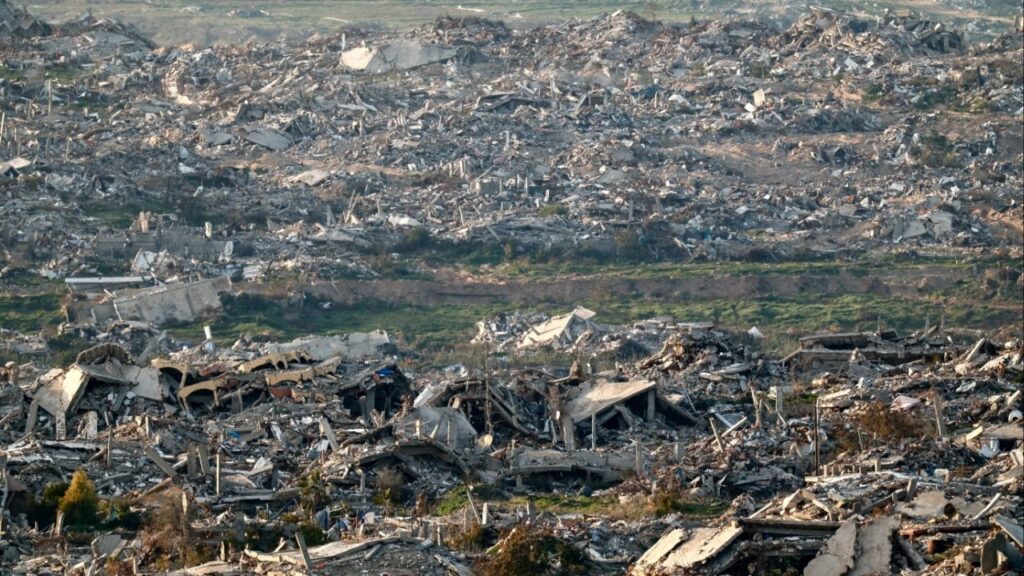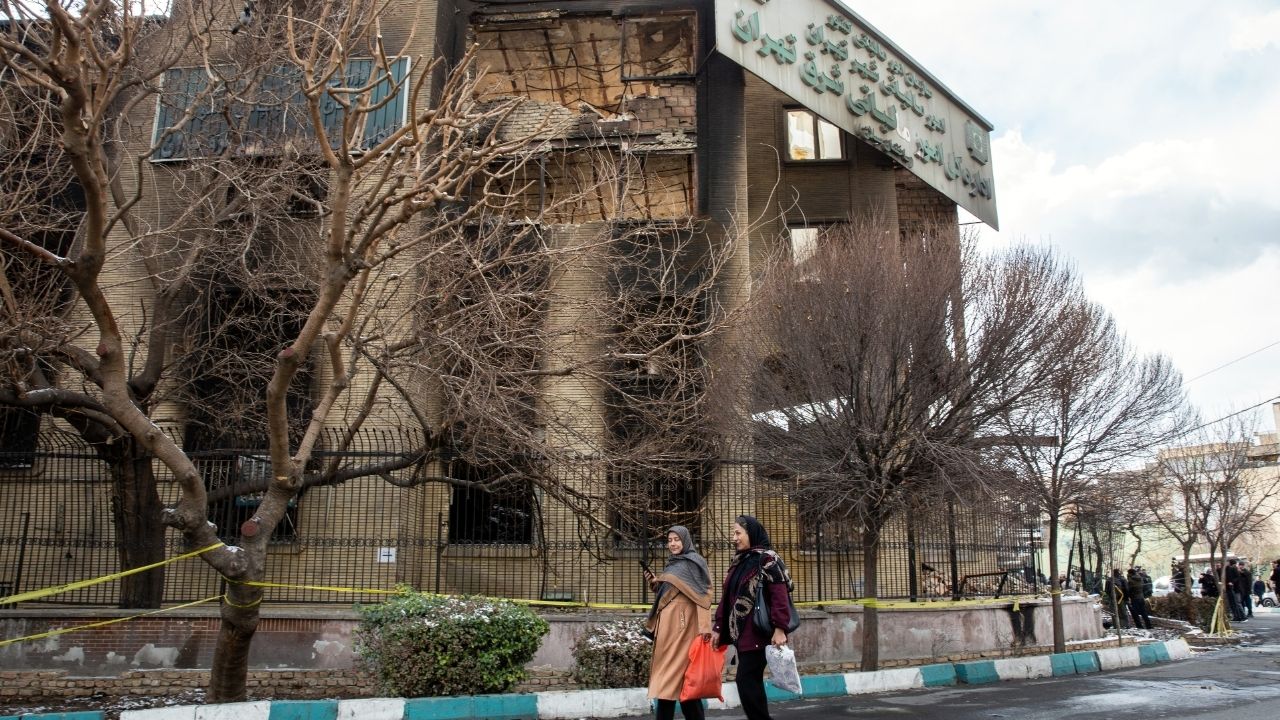
A photograph taken during a tour for international news media on Wednesday, Jan. 21, 2026, shows a tax office that was burned during protests in Tehran. Iran and its militia allies say they will respond aggressively in the region if attacked. A U.S. aircraft carrier and warships are approaching the region. (Arash Khamooshi/The New York Times)

Share
|
Getting your Trinity Audio player ready...
|
CAIRO — As U.S. warplanes and aircraft carriers approach the Persian Gulf, Iran and its regional allies are warning they will respond aggressively to a potential strike.
The fiery rhetoric has been a standard part of Iran and its allies’ messaging to Washington. The last time those words were tested — when U.S. warplanes joined Israel in a 12-day war against Iran last June — the result was a relatively minimal retaliation.
The recent surge in threats follows President Donald Trump’s announcement Thursday that he was sending a large naval force, which he called an “armada,” into the Persian Gulf. “We’ll see what happens,” he told reporters as he returned from the World Economic Forum in Davos, Switzerland.
Officials in the Middle East are increasingly worried the United States will strike Iran in the coming days, an attack that could trigger a cycle of retaliation against U.S. bases across the region by Iran and its proxy groups.
USS Abraham Lincoln
As of Monday, the aircraft carrier USS Abraham Lincoln, accompanied by three warships equipped with Tomahawk missiles, entered Central Command’s area of responsibility in the western Indian Ocean, said a U.S. official who spoke on condition of anonymity to discuss those details. If the White House were to order attacks on Iran, the carrier could, in theory, take military action within a day or two. The United States has already sent a dozen F-15E attack planes to the region to strengthen strike aircraft numbers, according to U.S. officials.
Trump has repeatedly warned he could strike Iran since a wave of demonstrations erupted in late December and then swelled to nationwide protests. In early January, he said the United States was “locked and loaded” if “innocent protesters” were killed. Days later, he encouraged protesters to keep demonstrating, saying “help is on its way.” Soon after that, Iranian security forces unleashed a brutal crackdown that rights groups say has killed thousands of people.
There was no U.S. military action after the killings.
Iranian officials have now intensified their frequent warnings against an attack, with several officials now releasing statements daily.
On Monday, Iran’s foreign and defense ministries vowed retaliation.
“Our response will be more decisive and more painful than before if we become the target of a U.S.–Zionist attack,” Reza Talaei-Nik, the Defense Ministry spokesperson said, in reference to the June war that Israel launched against Iran, and which was briefly joined by U.S. warplanes.
Iran ‘Fully Prepared’
Hours later, the commander of Iran’s navy said the country’s armed forces are “fully prepared to safeguard the nation’s sovereignty,” according to the semiofficial news agency ISNA.
A massive billboard was unfurled in a central square of Tehran, Iran’s capital, on Sunday, depicting a bloodied aircraft carrier in the shape and colors of the American flag. It showed a blue flight deck, studded with fighter jets exploding into white stars, and water streaming behind in streaks of red and white. A slogan written in both Persian and English read: “If you sow the wind, you will reap the whirlwind.”
Iran’s regional dominance has starkly diminished over the past two years. Israel has attacked and weakened the Lebanese force Hezbollah, long seen as Tehran’s most potent regional ally, and the Palestinian militant group Hamas, in the wake of the Hamas-led Oct. 7, 2003, attack on Israel that sparked the war in the Gaza Strip.
The perceived threat posed by Iran’s regional alliance, which also includes militias in Iraq and the Houthi forces in Yemen, was further undermined by those forces’ apparent reluctance to retaliate during the June war, which battered Iran’s nuclear and military sites.
Trump warned earlier in January that if Iran carried out its threats to execute protesters that it had arrested, he would act. He has since argued that those threats of intervention stopped more than 830 executions — a claim that Iran’s prosecutor general denied as “completely false.”
It remains unclear whether Iran has executed any protesters, in part because information has been hard to verify amid a widespread digital and communications blackout across the country.
Earlier this month, Trump appeared to back away from a strike, after receiving a string of urgent warnings from several Middle East leaders that it could spark a regional conflagration. Iranian officials had told their counterparts in the Gulf and Iraq that their countries would not be spared in retaliatory attacks against U.S. military sites they host, according to regional officials.
But since the movement of U.S. warships and fighter jets, Iran’s proxies have begun to openly threaten to join their patron for any retaliation.
Kevin Donegan, a retired vice admiral and former top Navy commander in the Middle East, said that the outcome of any attack on Iran’s government is unpredictable, which is why Trump’s likely aim, he said, would be to improve his position in future negotiations rather than an outright military victory.
“Despite past attacks against their missile systems and command-and-control, they still have a lot of missiles and drones that can strike U.S. bases in the region. So an element of this U.S. posture will be reinforced defense,” he said. “I see this current posture of forces as a maximum pressure move with a ‘deal’ being the desired outcome.”
—
This article originally appeared in The New York Times.
By Erika Solomon, Eric Schmitt and Hwaida Saad/Arash Khamooshi
c. 2026 The New York Times Company
RELATED TOPICS:
Categories




What to Know About the Homeland Security Shutdown