

|
Getting your Trinity Audio player ready...
|
The Trump administration laid out an ambitious and highly speculative vision for the future of the Gaza Strip at the World Economic Forum in Davos, Switzerland, on Thursday, as Washington tries to advance the thorny ceasefire between Israel and Hamas.
The presentation by Jared Kushner, President Donald Trump’s son-in-law, featured slides that depicted gleaming skyscrapers rising on Gaza’s coast and the construction of entirely new cities. The plan would require investment of at least $25 billion in the devastated Palestinian enclave, according to the proposal.
Plan to Rebuild Gaza
Gaza would be rebuilt in phases, he said, starting with the south. The southern city of Rafah — which Israel largely razed during its war against Hamas — would be rebuilt in two to three years, he said.

“We said, ‘Let’s plan for catastrophic success,’” Kushner said in Davos, adding that there was no “Plan B.”
At this point, however, those ideas exist mostly on paper.
Hamas has not agreed to lay down its arms and disband its battalions of fighters. The United States has struggled to persuade countries to contribute soldiers to a proposed peacekeeping force for Gaza. And it is far from clear who would provide the billions that the Trump administration’s lofty plans would require.
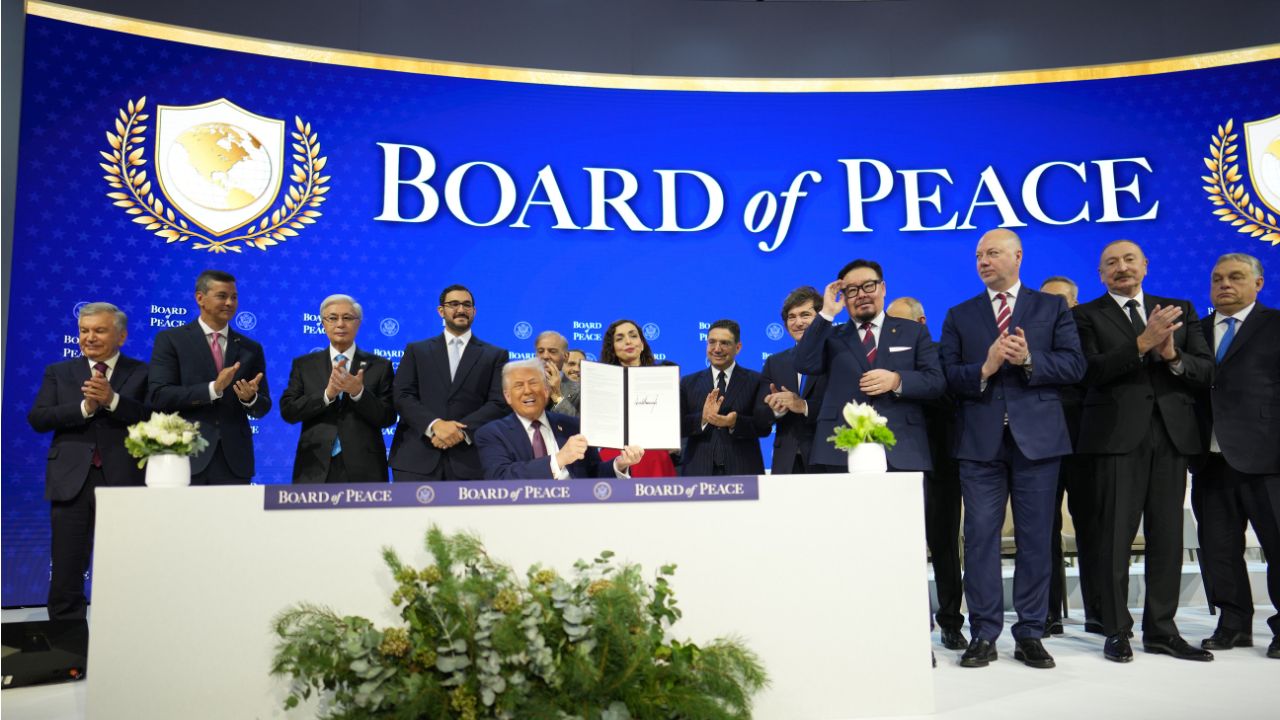
Kushner outlined the proposal during a gathering in a Davos conference room to formally inaugurate Trump’s “Board of Peace,” which the president said last year would help oversee the Israel-Hamas truce and the reconstruction of Gaza.
At the ceremony, Ali Shaath, the head of a Palestinian committee of technocrats that the board would oversee, said that the Rafah border crossing with Egypt is scheduled to reopen next week. But Israel has not confirmed that. Israeli authorities have vowed to keep the border closed until Hamas returns the body of Ran Gvili, the last Israeli captive whose remains are still in Gaza.
Obstacles in Rebuilding Gaza
Last week, the Trump administration circulated a proposed charter for the Board of Peace that would expand its mandate to other conflicts. That has provoked fierce controversy, with critics now calling the board an attempt to set up a Trump-dominated alternative to the United Nations. Since then, some allies of the United States — including France, Britain, Norway and Sweden — have said they would not join it.
A spokesperson for Prime Minister Benjamin Netanyahu of Israel said this week that Israel would join the board, although the country has expressed reservations about the makeup of one of the board’s key committees.
Among the world leaders who officially joined the board at the Davos gathering Thursday were right-wing populists like President Javier Milei of Argentina and Viktor Orban, the Hungarian prime minister. Close Arab allies of the United States like Saudi Arabia, the United Arab Emirates and Qatar also sent representatives to sign on.
At the signing ceremony, Trump seemed to concede that disarming Hamas still posed a major obstacle to his plans for Gaza. He did not say how, exactly, he would pressure the militants to lay down their arms.
“They were born with rifles in their hands,” Trump said. “But they have to give up their weapons, and if they don’t do that, it’s going to be the end of them.”
Hamas has agreed to hand over day-to-day governance of Gaza to the committee led by Shaath. But it has not agreed to hand over control of the enclave’s security.
Analysts say the committee’s success will partly depend on whether Israel eases the restrictions it has imposed on Gaza. In recent months, Israel has kept the Rafah border crossing all but closed, even though it had agreed to open it as part of the truce agreement.
Kushner said the United States would host a Gaza investment conference for the private sector in Washington in a few weeks. He conceded that moving money into the Palestinian enclave could be “a little risky” but said it would also provide “amazing investment opportunities.”
—
This article originally appeared in The New York Times.
By Aaron Boxerman/Doug Mills
c. 2026 The New York Times Company