
|
Getting your Trinity Audio player ready...
|
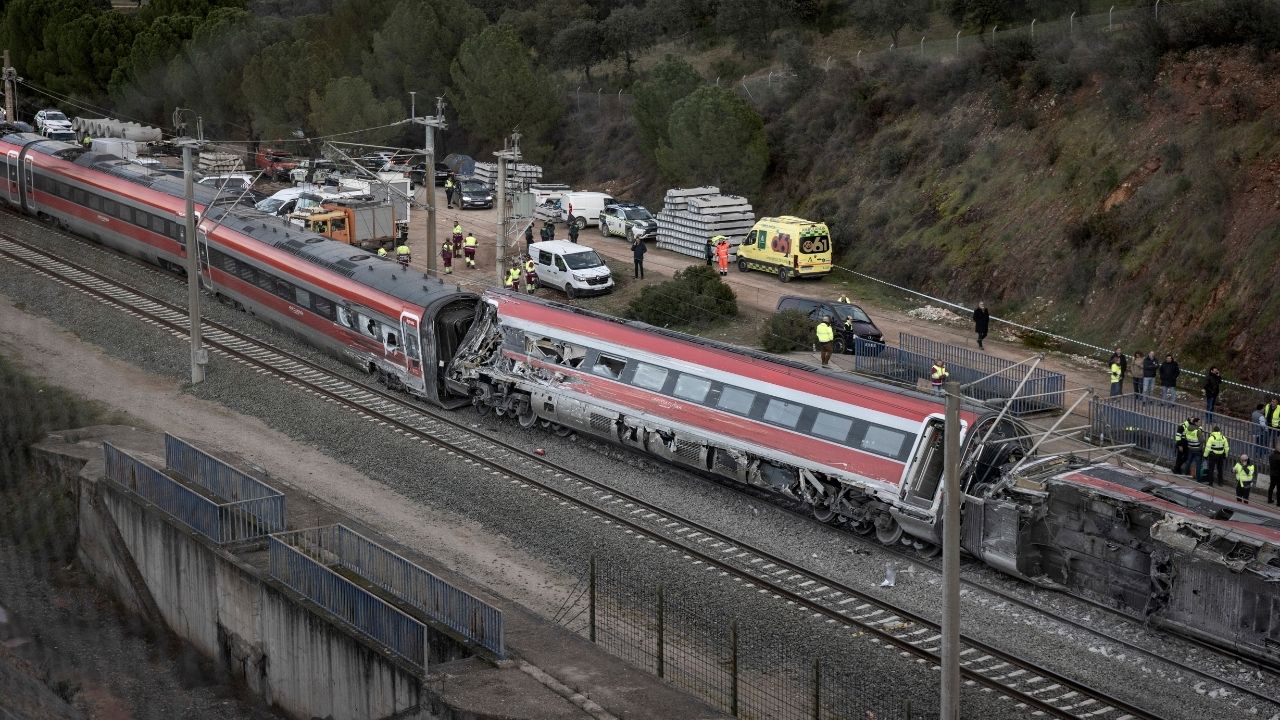
Spanish authorities on Monday were investigating the cause of a high-speed crash between two trains in southern Spain the night before that killed at least 39 people, as survivors described harrowing scenes of bodies thrown from mangled train cars.
Authorities said the collision occurred about 7:45 p.m. local time Sunday in Adamuz, a small town near the city of Córdoba, along the main high-speed rail line connecting southern Spain with Madrid, the capital. Spain’s transport minister warned that the death toll was “not final.” The crash was the deadliest in Spain since at least 2013.
Juanma Moreno, the president of the regional government of Andalusia, told Spain’s RNE radio that some bodies had been found hundreds of feet from the crash site. He said rescuers feared that more people might be trapped beneath the train cars.

According to a provisional investigative report, the two rear cars of a northbound train traveling to Madrid from Málaga, on the country’s southern coast, derailed as it was approaching the Adamuz train station. The derailed train crossed the track as an oncoming southbound train, operated by Spain’s national rail company, Renfe, was arriving. The first two cars of that train, which had departed from Madrid and was heading for the southern city of Huelva, west of Seville, fell down a 12-foot embankment, the report said.
“The accident is extremely strange,” Óscar Puente, Spain’s transport minister, told reporters, saying it took place on a straight stretch of track. “All the experts we have consulted are extremely baffled.”
Work to replace the tracks, switches and junctions was completed in May, he said, and the derailed Iryo train had its most recent inspection Thursday, according to the company.
Álvaro Fernández Heredia, the president of Renfe, said the tragedy wasn’t caused by “a speeding issue.” Records show that one train was traveling about 127 mph and the other about 130 mph, he noted. The speed limit was about 150 mph.
The Spanish Union of Railway Drivers said it had sent a letter in August asking the state-owned rail operator and Spain’s railway safety agency to look into what could be flaws on lines across Spain, including at the site of the train crash. The union emphasized Monday that it did not know the cause of the collision.
Iryo said about 300 passengers were on its train during the crash. Renfe has not said how many passengers the second train was carrying.
Here’s What Else To Know:
— The victims: The Andalusia emergency service said 43 victims remained hospitalized Monday afternoon. Of 12 in intensive care, nine were in serious condition, it said. The Córdoba city government issued an urgent appeal for doctors.
— The scene: Rafael Ángel Moreno, the mayor of Adamuz, described the scene of the crash as “utter chaos.” He said the town’s residents had used their cars as makeshift ambulances and brought food, water, tools and blankets to the site.
— Suspensions: High-speed train service across much of southern Spain was suspended Monday, Spain’s railway infrastructure operator said on social media. Renfe said that rail service could be disrupted for days.
— 2013 crash: A high-speed train derailment in Galicia, Spain, killed 80 people and injured 140 others in 2013. A court was told the driver had been on the phone and the train was traveling at 153 kph — almost twice the speed limit — at the time of the crash.
— The network: After China, Spain has the longest high-speed rail network in the world, according to the International Union of Railways. About 40 million passengers use the network every year, according to Renfe, and its average speeds rival those of global leaders like those in Japan and France.
—
This article originally appeared in The New York Times.
By Jason Horowitz and José Bautista/Finbarr O’Reilly
c. 2026 The New York Times Company