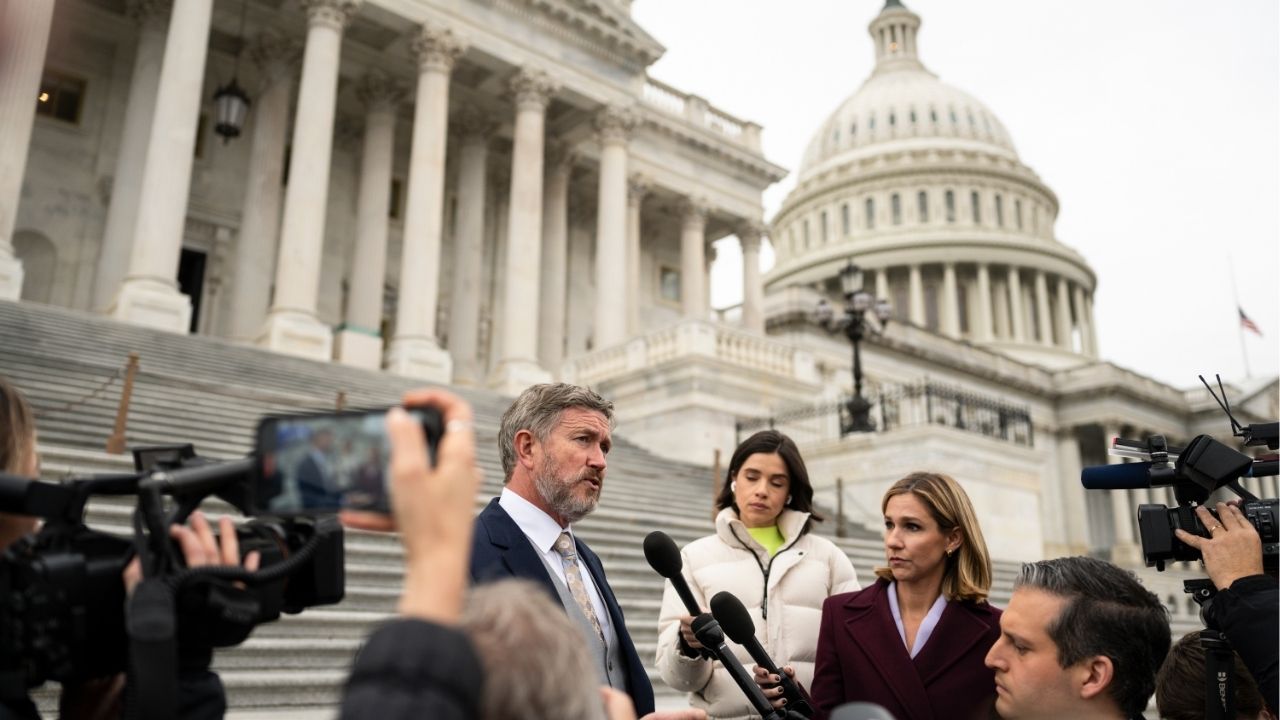
Rep. Thomas Massie (R-Ky.) speaks to reporters outside the Capitol as the House was voting in Washington, on Tuesday, Nov. 18, 2025. In an interview on Jan. 7, he slammed “a flimsy constitutional argument” for the United States’ seizure and prosecution of Nicolas Maduro. (Tierney L. Cross/The New York Times)

Share
|
Getting your Trinity Audio player ready...
|
President Donald Trump has almost no Republican critics in Congress. Rep. Thomas Massie of Kentucky is an exception.
After clashing with Trump over the Epstein files over the past year, Massie has emerged as the most forceful Republican opponent of the U.S. intervention in Venezuela. He has pressed for a war powers resolution to stop Trump from using military force without congressional approval or a declaration of war. The Senate passed such a resolution Thursday.
One result of his critiques: He faces a Trump-backed primary challenger whose campaign has raised more than $1 million for what is expected to be a hard-fought race.
The New York Times spoke to Massie by phone Wednesday night, about the same time that Trump also sat down for a lengthy interview with the Times, to understand the Republican representative’s thinking about the legality and the politics of the Venezuela intervention.
Calling the U.S. indictment against Nicolás Maduro “preposterous” and saying it was based on “a flimsy constitutional argument,” Massie blasted the administration for conflating fentanyl with cocaine. He said that from the beginning, “there’s been gaslighting” on Venezuela.
This interview has been condensed and lightly edited for clarity.
Q: Have you heard from any other Republican members who agree with you on Venezuela, either publicly or privately?
A: There are two categories. There are those who will concede to me privately that this isn’t a good thing. That’s really just one or two. Then there are those who know better, but their political reality is that there’s no way they could articulate that publicly. So they’ve convinced themselves in their own minds that this is OK, and they’ve got interesting ways of rationalizing it.
Q: How many Republican lawmakers do you think are saying one thing but believe another?
A: I think there’s a couple dozen. The political reality is that they’re dead in the water if they call out the president.
Q: How do you think this plays out in your primary race, with national polls suggesting that Republican voters widely approve of the Venezuela intervention?
A: I expect my district is similar. I do think the bloom is going to fall off the rose eventually, possibly before my primary. This isn’t going to get better with age.
People are going to realize that free oil doesn’t mean free oil to them. The oil is going to the oil companies. Ultimately, this military adventurism is not going to bring prices down across the board. Right now, it’s a politically perilous position for me to take, but I think with age, it might start looking better.
Q: How do you think this plays out a little longer term with the Republican base?
A: I think the base will move on this as things go south. I said in my floor speech before this happened that we’re not going to get a George Washington or Thomas Jefferson running Venezuela. It’s just not going to happen.
Q: Were you surprised at those polling numbers about strong Republican support for the Venezuela action?
A: Not really. I remember back to Desert Storm, the first Iraq War. That was so popular in the beginning, and it didn’t last long. I would have been about 18, and even then I was more libertarian-leaning, but I got caught up in the excitement. It’s always exciting to see the equipment being used and a mission well executed by our military. In the beginning, and when it’s a surprise attack, the other side doesn’t really have much of a chance.
Q: Do you think the Venezuela operation is illegal?
A: I think it’s illegal and unconstitutional.
Q: So does that mean Trump should be impeached?
A: That’s not something I would do.
Here’s the biggest problem: There’s no limiting principle here. The executive branch hasn’t described a legal framework that would keep them from doing this again in any country of their choosing. People like Lindsey Graham and Marco Rubio are almost giddy to tell you that they would do it in Cuba or Colombia or maybe even Greenland.
Q: How likely do you think any of those really are? Would you hazard a guess?
A: I wouldn’t bet on any of those countries in particular, but in the next three years it seems almost certain that we’ll be engaged in regime change at least once or twice again.
—
This article originally appeared in The New York Times.
By Jennifer Medina/Tierney L. Cross
c. 2026 The New York Times Company
RELATED TOPICS:
Categories


Trump Says He Is Planning to Talk to Iran