|
Getting your Trinity Audio player ready...
|
A study from Westlands Water District lays out the difference on the local economy between when farmers have water and when they don’t.
The district’s third economic impact report, which was released Wednesday, compares 2022 , a year following scant rainfall and a 0% water allocation — later marginally increased — with 2019, a plentiful water year and a 75% allocation.
As farmers planned for lower water allocations in 2022, increases in farm unemployment, poverty, and decreases in tax contributions followed, said Michael Shires, a consultant for Westlands.

He said the impact goes beyond the buyers and sellers of crops but extends to the farm equipment companies reliant on ag production.
“It’s also the folks that are hulling almonds, who are processing tomatoes, and processing grapes for raisins,” Shires said. “And then it’s all the people who work for those. It’s the community around them that rely on them to come and spend their money in their local grocery store.”
Shires said to balance employment and food security, the region needs more water storage and recharge.
“We spend a lot of time saying this is a good idea, we’ve been really slow at actually acting on it and in fact, are actually in the active process of eliminating some of that surface storage,” Shires said.
Related Story: Costa, Gray Propose $4.4 Billion for Central Valley Water Projects
2022 Worse Than Even the 2015 Drought Year
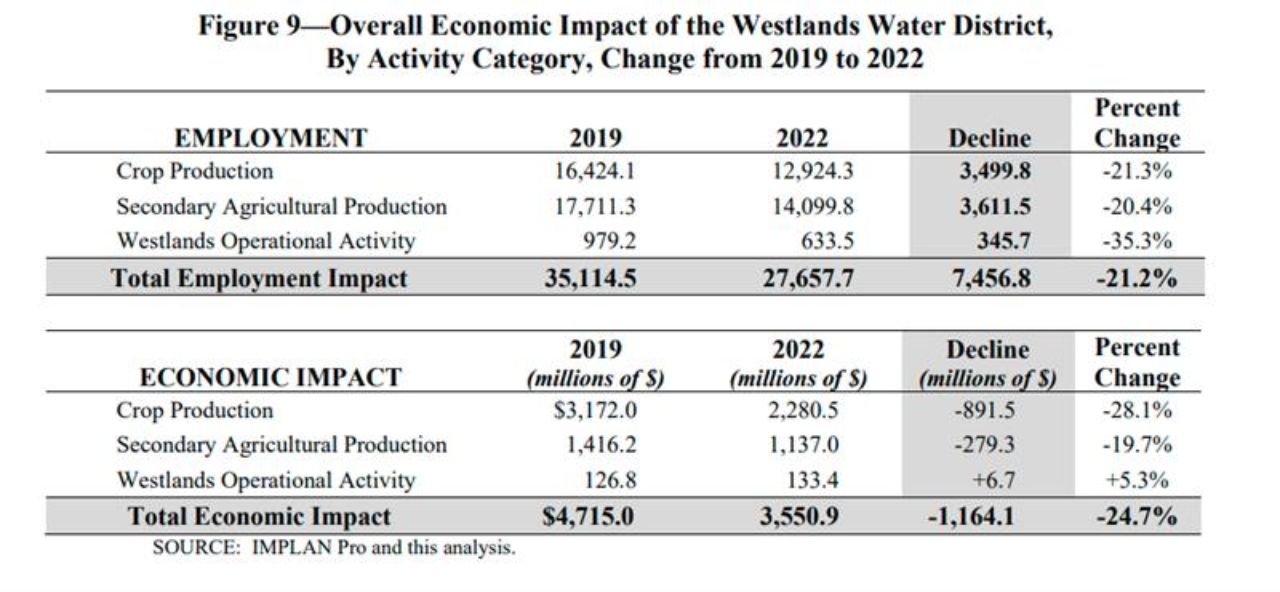
The study pegs $2.28 billion in direct impact from ag in Westlands in 2022. Adding the indirect impact, ag activity created $3.55 billion in total effect, leading to 27,657 jobs. That’s a 28% decline in direct economic activity and a 25% decline in total activity from 2019, when farm activity created 35,114 jobs.
That’s lower even than 2015, when ag in Westlands created $2.6 billion in direct effects and $3.6 billion indirectly, employing 28,851 people.
Shires directly correlates that to scant water allocations and land fallowing.
“We lost $900 million of agricultural production over those three years because of less water available, which then spilled over into all of these other areas of the economy,” Shires said. “A total economic impact of something like $1.2 billion. This a large number — 7,500 jobs.”
Shires estimates about $100 million in lost tax revenues to various governments, about $25 million to local governments, and $75 million to the federal government.
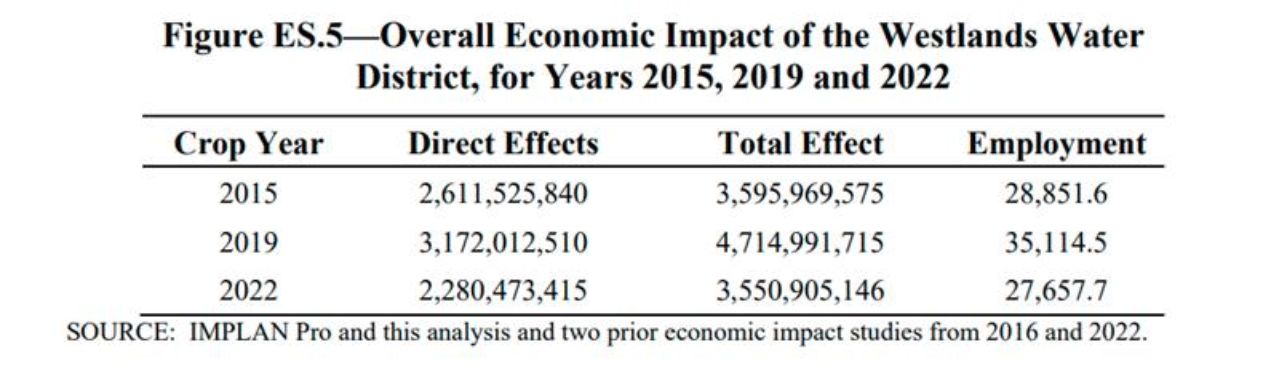
Westlands also helps create food security, Shires said, as the fruit and nut production in the county accounts for 3.3% of U.S. total production and 2.8% of all vegetable and melon production. That 2.8% figure marks a decrease from 5.4% recorded in 2019, according to the study.
“Food is a national security issue,” Shires said. We want to make sure that we have our own food supply. I mean, one of the lessons we did learn from COVID when there were 200 ships parked offshore who couldn’t get onshore and literally produce is rotting on the ship. We can’t completely rely on foreign sources to backfill things.”
7,500 Jobs Lost From 2019 to 2022: Westlands Study
The report states that decreased water allocation exacerbate poverty issues in Fresno and Kings counties, where farm jobs directly account for 9.5% in Fresno County and 15.3% in Kings County.
“We had 7,500 more people who weren’t working in that sector,” Shires said. “At that same time, you had all these people probably going on public assistance programs to help support their families as a transition, at least unemployment.”
Fallowed Land Spikes in 2022. Could It Contribute to Valley Fever?
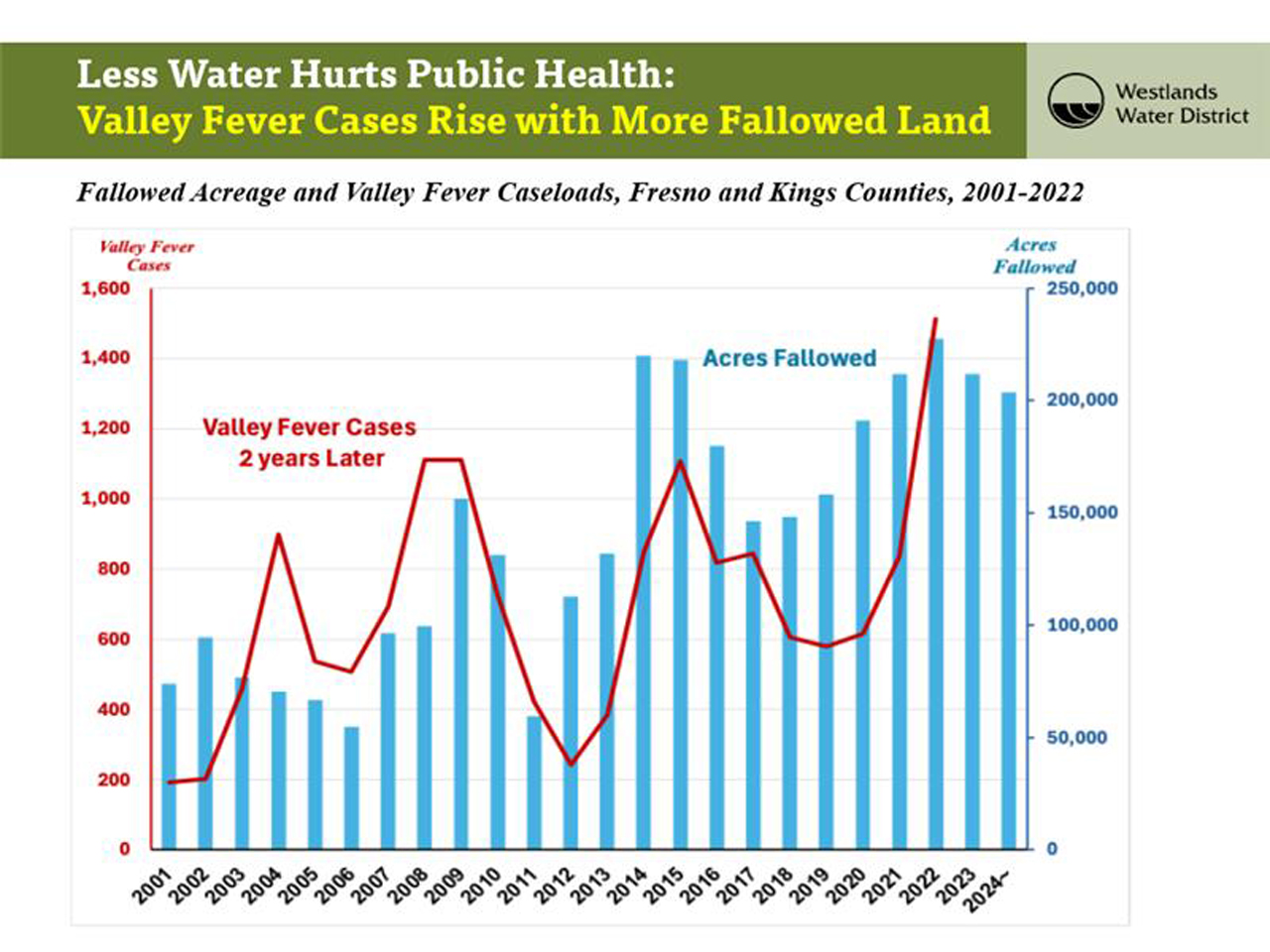
Fallowed land within Westlands reached highs in 2022, spiking past 200,000 acres. Shires drew a connection between the amount of fallowed land and Valley Fever disease caused by a fungus that lives in the soil.
While he kept from drawing a scientific correlation, when charted, rises in Valley Fever cases follow rises in fallowed Westlands acreage.
The same parallel can be drawn for rises in rodent populations, which thrive in undisturbed land. A study done earlier this year by the California Department of Food and Agriculture documented the outsized damage caused by rodents on irrigation and farm operations. Shires drew a connection between rodent populations and predatory bird species, which then can cause bird strikes on military aircraft flying out of Naval Air Station Lemoore.
The U.S Centers for Disease Control report about 20,000 cases of Valley fever are reported each year in the U.S., primarily in California and Arizona. Cases may go underreported, however, and some believe the true number may be closer to 200,000 to 360,000 annually. On average, about 200 people die of the disease each year.
Board chair of the Fresno Chamber of Commerce and farmer Nick Rocca shared at the Westlands presentation how Valley Fever impacted his family.
“My father actually was diagnosed with Valley fever, and the diagnosis of that ended leading to other health complications that ultimately led to his death, and so Valley fever is a huge issue,” Rocca said.
Westlands Farmers Among Most Water Efficient in World: Rocca
By the time Westlands does its next economic report, California’s Sustainable Groundwater Management Act will be further implemented. The landmark law reduces groundwater pumping to protect the aquifer and prevent further land subsidence. In 2022, water agencies had just begun facing pumping restrictions.
As fallowed land increases and water restrictions become stiffer, Shires said the best way to prevent further harms to the Central Valley economy is to increase water availability.
Reps. Jim Costa, D-Fresno, and Adam Gray, D-Merced, put forth a bill this week to provide $4.4 billion to improve water infrastructure. A majority goes to canal repairs and conveyance. Studies have shown that repairs would significantly decrease water loss, but farmers still need increased storage, said Rocca, who is the incoming president of the Fresno County Farm Bureau.
“The largest water storage we have is our snowpack. So how do we manage the snowpack and capture as much runoff as we can? That will save us for generations to come,” Rocca said. “You talk about legacy, you talk about sustainability — farmers are using the water here in California more efficiently than almost any part of the world.”