
|
Getting your Trinity Audio player ready...
|
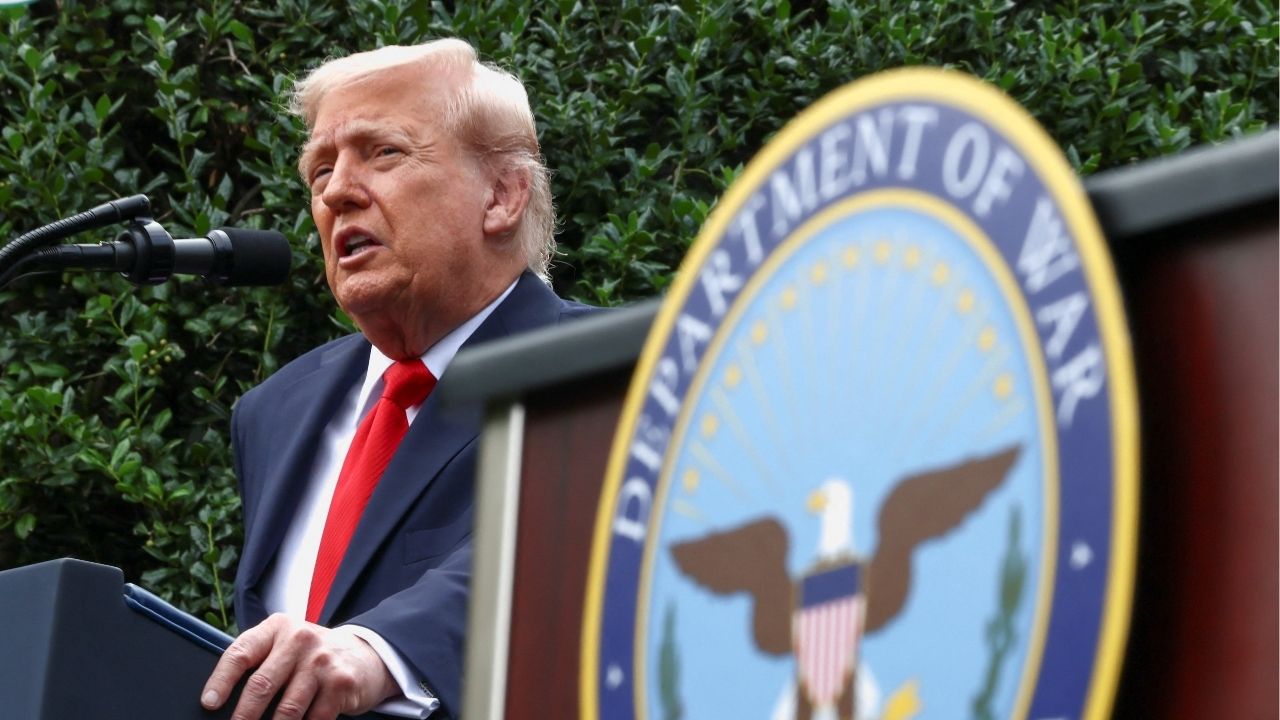
President Donald Trump on Thursday plans to sign into law a nearly $1 trillion annual defense policy bill, despite its provisions providing new aid to Ukraine and reining in his ability to dial down U.S. involvement in the defense of Europe.
The fiscal 2026 National Defense Authorization Act, or NDAA, authorizes a record $901 billion in annual military spending, $8 billion more than Trump requested.
The sweeping legislation determines everything from how many ships, aircraft and missile systems are bought, to a pay raise for the troops, to how to address geopolitical threats. The measure Trump plans to sign at 6 p.m. ET is a compromise, combining separate measures already passed in the House of Representatives and Senate before it was passed this month.

In a break with Trump, whose Republicans hold majorities in both the House and Senate, the NDAA includes several provisions to boost security in Europe.
Trump has been cool to bolstering European security, feeling the allies should pay their own way. His recently published National Security Strategy is seen as friendly to Russia and a reassessment of the U.S. relationship with the continent.
The fiscal 2026 NDAA provides $800 million for Ukraine – $400 million in each of the next two years – as part of the Ukraine Security Assistance Initiative, which pays U.S. companies for weapons for Ukraine’s military.
It comes as Trump’s team is locked in negotiations with Ukraine and Russia in a bid to bring about a halt to Russia’s invasion of Ukraine.
The defense law also authorizes the Baltic Security Initiative and provides $175 million to support Latvia, Lithuania and Estonia’s defense. And it limits the Department of Defense’s ability to drop the number of U.S. forces in Europe to fewer than 76,000 and bars the U.S. European Commander from giving up the title of NATO Supreme Commander.
The White House said in a statement that Trump backed the bill because it codifies into law aspects of many of his executive orders, including funding the Golden Dome missile defense system and eliminating diversity, equity and inclusion programs at the Pentagon.
Members of Congress have passed the NDAA every year for 65 straight years, though that streak almost ended during Trump’s first term.
Trump vetoed the NDAA in December 2020, because he objected to its call to rename military bases and other facilities named for Confederate figures and disagreed with its approach to legal protections for tech companies, among other issues.
However, Congress overrode his veto in January 2021, just before he left office, the only veto override of Trump’s first term.
—
(Reporting by Patricia Zengerle; Editing by Colleen Jenkins and Chizu Nomiyama )