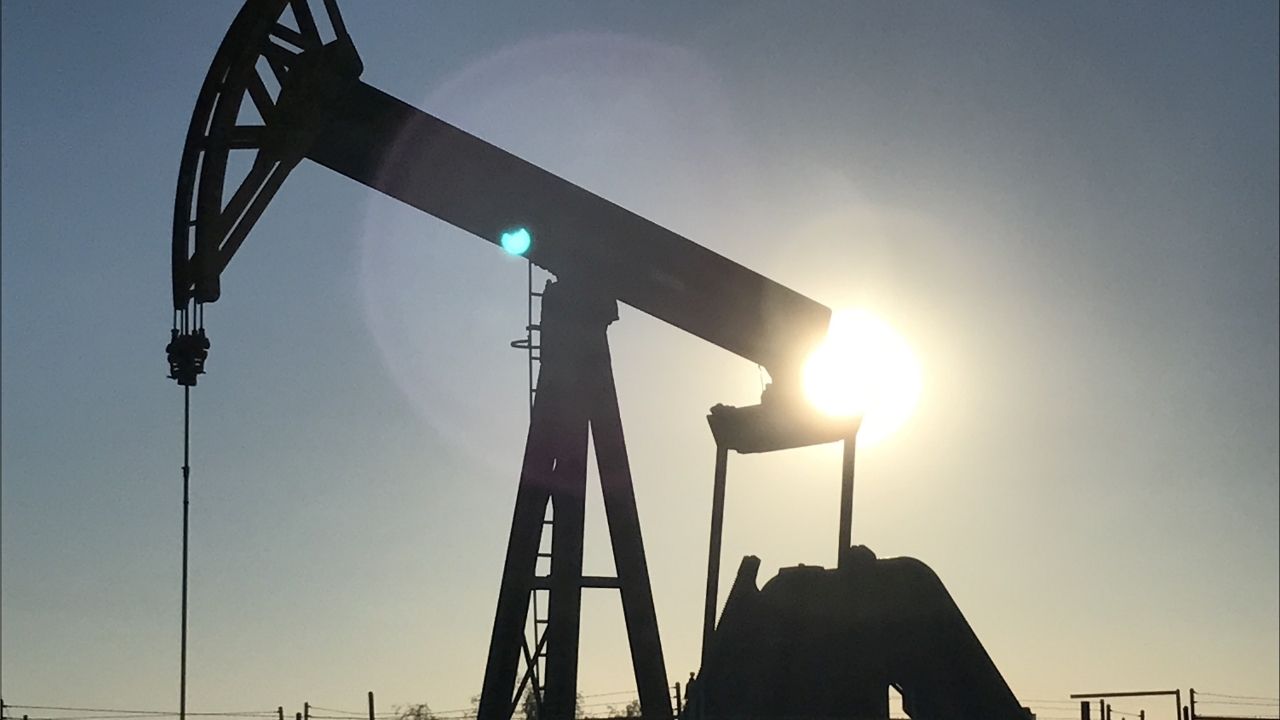
An oil pump at sunrise near Midland, Texas, U.S., May 3, 2017. Picture taken May 3, 2017. (Reuters/Ernest Scheyder)

Share
|
Getting your Trinity Audio player ready...
|
Oil prices settled marginally higher on Thursday as investors assessed the likelihood of further U.S. sanctions against Russia and the supply risks posed by a blockade of Venezuelan oil tankers.
Brent crude closed 14 cents, or 0.2%, higher at $59.82 per barrel, while U.S. West Texas Intermediate crude was up 21 cents, or 0.4%, at $56.15 per barrel.
“Crude futures are trying to find support from the Venezuelan oil export blockade, which if it continues will likely cause production in the area to be shut in with no destinations to ship out to,” said Dennis Kissler, senior vice president of trading at BOK Financial.
U.S. President Donald Trump on Thursday said he believes talks toward ending the war in Ukraine are “getting close to something” ahead of a U.S. meeting with Russian officials this weekend.
The U.S. is preparing another round of sanctions on Russia’s energy sector in the event Moscow does not agree to a peace deal with Ukraine, Bloomberg reported on Wednesday, citing people familiar with the matter. A White House official told Reuters that Trump had not made any decisions on Russian sanctions.
“If no Russia/Ukraine peace deal is reached, the attacks on Russia could escalate, quickly tightening supplies, and if you add in the blockade on Venezuelan oil, crude prices may very well be a bit underpriced here,” Kissler said.
Risks to Supply Mount
Further measures targeting Russian oil could pose a greater supply risk to the market than Trump’s announcement on Tuesday that the U.S. would blockade tankers under sanctions entering and leaving Venezuela, ING analysts said in a note.
Britain imposed sanctions on 24 individuals and entities as part of its Russia sanctions regime, including on Russian oil companies Tatneft and Russneft, a government notice showed on Thursday.
The Venezuela blockade could affect 600,000 barrels per day of Venezuelan oil exports, mostly to China, but 160,000 bpd of exports to the U.S. would likely continue, ING said.
Chevron vessels were continuing to depart for the U.S. under a previous authorization from the U.S. government.
Venezuela on Thursday authorized two unsanctioned very large crude carriers to set sail for China, according to two sources familiar with Venezuela’s oil export operations.
It was not clear how a U.S. blockade would be enforced. The U.S. Coast Guard last week took the unprecedented step of seizing a Venezuelan oil tanker, and sources said the U.S. was preparing for more such interdictions.
Venezuelan crude makes up around 1% of global supplies.
Analysts at Bank of America anticipate the lower price of oil will reduce the amount of supply. If WTI prices average $57 a barrel in 2026, in line with their projection, U.S. shale oil production could contract by 70,000 bpd.
—
(Reporting by Enes Tunagur, Stephanie Kelly and Colleen Howe; Editing by Barbara Lewis, Nia Williams and Paul Simao)
RELATED TOPICS:
Categories


Fresno Police Search for Armed Gunman Who Robbed USPS Worker

Fresno Activists Unveil Measure C Replacement for Ballot

CHP Safely Escorts Three Dogs From Crash Scene Near Coalinga
Oil Settles Down 4% as Trump Comments Ease Iranian Supply Concerns
Israel and Arab Nations Ask Trump to Refrain From Attacking Iran