|
Getting your Trinity Audio player ready...
|
Wall Street’s main indexes were little changed in volatile trading on Tuesday as healthcare and energy stocks led losses, while investors assessed a jobs report that signaled a cooling labor market and kept hopes for future interest rate cuts alive.
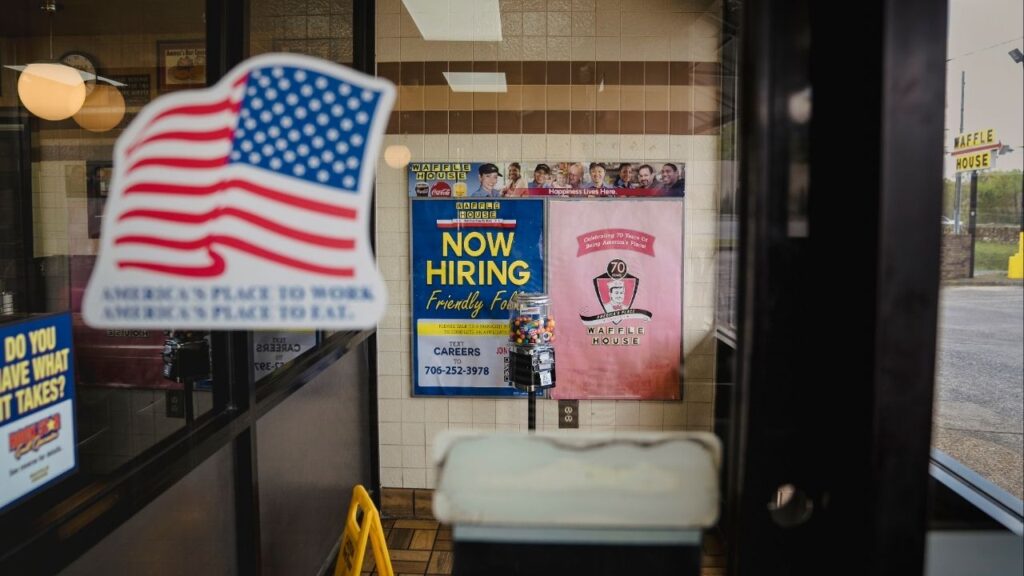
A Labor Department report showed U.S. job growth rebounded in November after nonfarm payrolls declined in October because of government spending cuts.
But the unemployment rate was at 4.6% in November as the labor market weakened against the backdrop of economic uncertainty stemming from President Donald Trump’s aggressive trade policy.

The data offered clarity on the state of the labor market after a recent historic government shutdown deprived both investors and the Federal Reserve of official figures. Policymakers broadly acknowledged signs of a weakening jobs market when the central bank lowered rates last week.
“When the unemployment rate moves up like this, it does fuel the potential for continued rate cuts. But as we’ve seen in the past, this is not a consistent trend,” said Peter Andersen, founder of Andersen Capital Management.
Investors raised expectations for rate cuts next year, according to data compiled by LSEG, and are now pricing in at least 58 basis points of reductions, higher than the 25 bps signaled by the central bank last week.
A separate survey showed U.S. business activity growth hit a six-month low in December.
Meanwhile, White House economic adviser Kevin Hassett, also one of Trump’s top contenders for the Fed chair post, said the central bank’s independence was important, amid concerns he might be too close to the president.
Major Markets Nearly Flat
At 09:56 a.m. ET, the Dow Jones Industrial Average fell 9.66 points, or 0.02%, to 48,406.44. The S&P 500 lost 1.97 points, or 0.03%, to 6,814.54, while the Nasdaq Composite gained 33.47 points, or 0.15%, to 23,090.89.
The S&P 500 and the Nasdaq hovered near their three-week lows as persistent uncertainty over rate cuts and concerns about lofty tech valuations continued to weigh on investor sentiment.
Five of the 11 S&P sub-sectors posted declines, with energy leading the losses, down 1.9%, tracking a more than 2% fall in oil prices.
Healthcare fell 1.1% as drugmaker Eli Lilly lost 1%. Pfizer slipped 3.1% after its 2026 profit forecast came below analysts’ estimate.
Heavyweight housing communication services rose 0.4%.
B. Riley shares jumped 23% after the investment bank reported a profit for the second quarter, compared with a year-ago loss in an overdue quarterly filing.
Humana lost 2.4% after the health insurer announced leadership changes.
Separately, a Reuters report said Nasdaq submitted paperwork with the U.S. Securities and Exchange Commission to roll out round-the-clock trading of stocks, months after the New York Stock Exchange and Cboe Global Markets announced similar plans.
Declining issues outnumbered advancers by a 1.12-to-1 ratio on the NYSE, while advancing issues outnumbered decliners by a 1.25-to-1 ratio on the Nasdaq.
The S&P 500 posted 10 new 52-week highs and one new low, while the Nasdaq Composite recorded 33 new highs and 104 new lows.
—
(Reporting by Johann M Cherian and Shashwat Chauhan in Bengaluru; Editing by Maju Samuel and Shilpi Majumdar)