
|
Getting your Trinity Audio player ready...
|
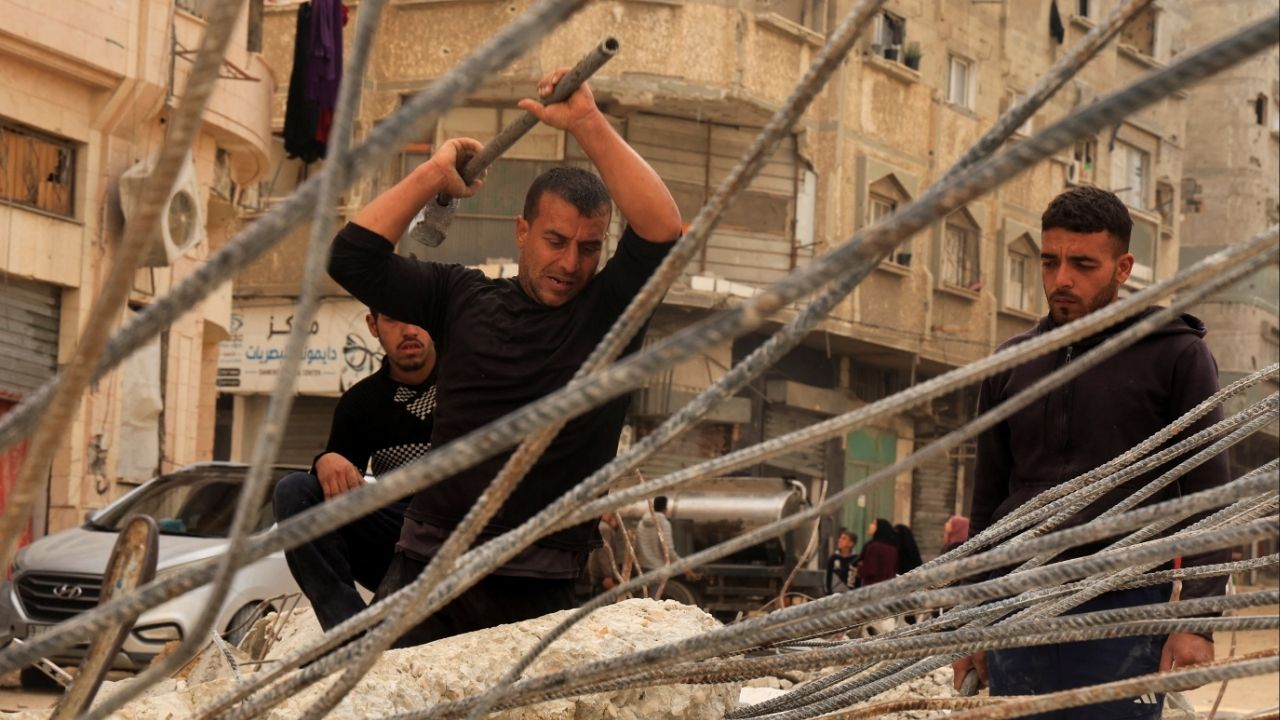
As winter bites in Gaza, displaced Palestinians set out every day to homes destroyed by Israel. There they rip out iron rods from the walls and use them to prop up their flimsy tents or sell to scratch out a living in an enclave that will take years to recover from war.
The rods have become a hot item in Gaza, where they are twisted up in the wreckage left by an Israeli military campaign that spared few homes. Some residents spend days pounding away at thick cement to extract them, others do the back-breaking work for a week or more.
With only rudimentary tools such as shovels, pickaxes and hammers, work proceeds at a snail’s pace.

UN Says War Generated 61 Million Ton of Rubble
Once the bars helped hold up cement walls in family homes, today they are destined for urgently-needed tents as temperatures at night fall. Heavy rainstorms have already submerged many Gazans’ meagre belongings, adding to their misery.
Palestinian father-of-six Wael al-Jabra, 53, was putting together a makeshift tent, trying to hammer together two steel bars.
“I don’t have money to buy wood, of course. So, I had to extract this iron from the house. The house is made of five floors. We don’t have anything apart from God and this house that was sheltering us,” he said.
In November, the U.N. Development Program said that the war in Gaza had generated 61 million tons of rubble, citing estimates based on satellite imagery.
Most of it can be cleared within seven years under the right conditions, it said.
A Rod Can Cost $15
A 10-meter metal rod costs displaced families $15 – a steep amount because many barely have cash.
The Palestinian militant group Hamas triggered the conflict after attacking Israel on Oct. 7, 2023, killing 1,200 people and taking 251 back to Gaza as hostages, according to Israeli calculations. Israel responded with a military campaign that killed over 70,000 people and laid waste to Gaza.
Carrying heavy buckets of rubble and pushing a wheelbarrow, Suleiman al-Arja, 19, described a typical day in the quest for iron rods.
“We pass by destroyed houses and agree with the house owner. He gives us a choice, whether to clean the house (clear the rubble) in exchange for iron or clean the house for money. We tell him that we want the iron and we start breaking the iron. As you can see, we spend a week, sometimes a week and a half,” he said.
Focus Is on Daily Struggle to Live
U.S. President Donald Trump promised to put together an international stabilization force and an economic development plan to rebuild and energize Gaza, which was impoverished even before the war. Palestinians in Gaza can’t look so far ahead even though a ceasefire was reached in October. Every day is a struggle for Palestinians who have seen peace plans come and go over many decades.
Their minds are focused on finding ways to survive, every single day.
“We do this work to get our food and drink, to cover our living expenses and not need anyone, so we earn a living through halal (legitimate) means and effort. These are my hands,” said Haitham Arbiea, 29.
Palestinians accuse Israel of depriving Gaza of the iron bars.
An Israeli official told Reuters that construction materials are considered dual use items – items for civilian but also potential military use – and will not be allowed into Gaza until the second phase of the U.S.-led peace plan. The official cited concerns that the materials could be used for the building of tunnels, which have been used by Hamas.
—
(Writing by Michael Georgy; Editing by Alexandra Hudson)