
|
Getting your Trinity Audio player ready...
|
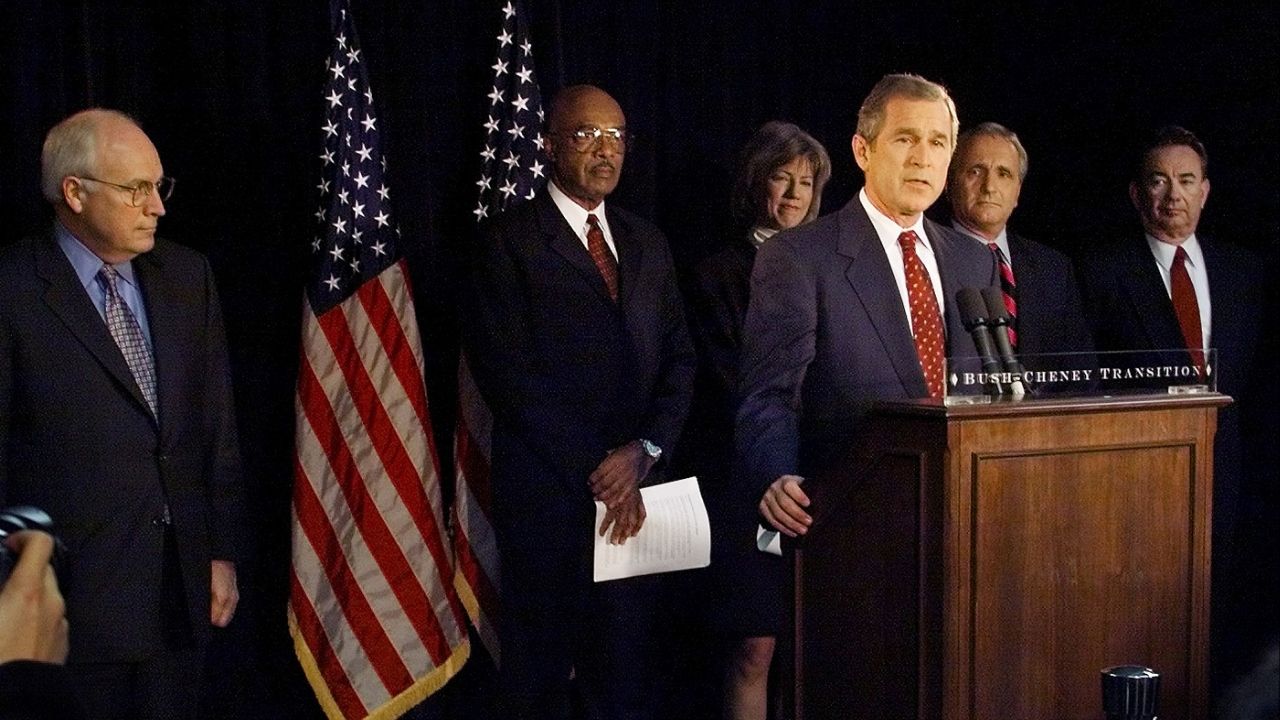
Rod Paige, who was President George W. Bush’s first secretary of education but who left amid a series of controversies that included attacks on foes of the No Child Left Behind law, died in Houston on Tuesday. He was 92.
His family announced his death in a statement, which did not specify a cause.
A former school superintendent in Houston, Paige arrived in Washington with little political experience but with a reputation as a champion of urban education. He was the nation’s first Black secretary of education, the first actual educator to lead the department and a symbolic star of the administration’s “compassionate conservatism.”

He quickly embraced Bush’s top legislative priority, the No Child Left Behind Act, which called for national changes in public education, including standardized reading and math tests and remedial action to raise student achievement and school performances. The aim was to close the gap between poor and rich children. It passed Congress with overwhelming bipartisan support, and Bush signed it on Jan. 8, 2002.
“No Child Left Behind was the cornerstone of major changes in the culture of education in this country,” Paige said in an interview for this obituary in 2018. “All of its elements were not successful, but its emphasis on testing, on the collection of information about the performance of pupils and schools, was a turning point, especially in the north.”
But the law’s complexity and the difficulties in putting federal mandates into effect on state and local levels were enormous. As a condition for receiving federal education funds, states had to set standards for student performance at various grade levels and demonstrate periodic progress by testing. All teachers had to be “highly qualified,” and they and their schools faced penalties for failure to meet goals.
Many disadvantaged students, including those with learning disabilities or English-language deficiencies, fell short of standards. Others raced ahead. Some good teachers and schools were put on probation. Many administrators called the yardsticks faulty. The system baffled parents. Governors said federal funds were insufficient. Teachers unions and state officials demanded changes in the law.
Less than a decade after Republicans had called for dropping education as a Cabinet agency, the department, under No Child Left Behind, had overnight become a juggernaut of American life, overseeing assessments of schools across the country. Paige, who presided over a $53 billion budget and once-unimaginable powers over American classrooms, traveled the country selling the new law. He used the passionate language of civil rights to defend it, likening its goals of educating children to “life itself.”
He also used zealous language to voice his personal views. In 2003, he said he would prefer to put a child in a Christian school, and suggested that Christians were morally superior to others. It raised a ruckus and was the first of a series of missteps.
In February 2004, as opposition to the law grew widespread and Paige as its point man became a symbol of its troubles, his frustrations boiled over. In a meeting with governors at the White House, he called the 2.7 million-member National Education Association, one of America’s largest labor unions, “a terrorist organization” because of its resistance to No Child Left Behind.
Paige apologized to the nation’s teachers but repeated his criticism of the union. “It was an inappropriate choice of words to describe the obstructionist scare tactics that the NEA’s Washington lobbyists have employed against No Child Left Behind’s historic education reforms,” he said. But Paige, who had come of age in segregationist Mississippi, added: “As one who grew up on the receiving end of insensitive remarks, I should have chosen my words better.”
In another scandal, Paige’s department acknowledged, in response to published reports, that it had poured $700,000 of taxpayers’ money into a “public relations” campaign to promote No Child Left Behind, using television segments crafted to sound like news reports and slipped into broadcasts as if they were genuine journalism.
Shortly after Bush was reelected in November 2004 and questions arose about his second-term Cabinet choices, Paige announced that he would resign at the end of the president’s first term. Bush soon nominated his chief domestic policy adviser, Margaret Spellings, as Paige’s replacement. But the fallout over his tenure continued.
In January 2005, USA Today revealed that Paige’s department had paid Armstrong Williams, a conservative Black syndicated columnist and broadcast commentator, $240,000 to promote No Child Left Behind to his audiences, and even to put Paige on the air to make pitches about the policy. The secretary called it a “straightforward distribution of information about the department’s mission.”
But the Federal Communications Commission ruled that the payments for television spots masquerading as news reports, and those for Williams’ promotions, were illegal. The press called them bribes. Bush disavowed them and forbade Cabinet members from paying commentators to promote his policies. Paige resigned weeks before Bush’s second-term inauguration.
“This debacle is unfortunately consistent with how the Education Department has been run under Mr. Paige,” The New York Times said in an editorial. “The management has consistently placed ideology ahead of the public interest. It has neglected the core goals of the No Child Left Behind Act — like strengthening public education by strengthening teachers — while advancing the interests of religious conservatives and others who favor funds for private school education at public expense.”
Roderick Raynor Paige was born in Monticello, Mississippi, on June 17, 1933, the oldest of five children of Raynor and Sophie (Stevens) Paige. His father was a public school principal and his mother a librarian. Rod and his siblings, Elaine, Alfretta, Raygene and James, attended local segregated schools. He graduated from Lawrence County Training School, a high school, in 1951.
A talented football player, he won an athletic scholarship and majored in physical education at Jackson State University, a historically Black school, where he earned a bachelor’s degree in 1955.
In 1956, he married Gloria Crawford. They had a son, Roderick Jr., and were divorced in 1982. In 2009, he married Stephanie D. Nellons, a regent of Texas Southern University, who had a daughter, Danielle, by a previous marriage.
Paige is survived by his wife and son; a stepdaughter, Danielle Robinson; and two sisters, Elaine Witty and Raygene Paige, according to the family statement.
In 2015, after more than 13 years of federally mandated testing and control of America’s public schools, President Barack Obama signed into law a sweeping rewrite of the No Child Left Behind Act, returning power to states and local districts to improve their troubled schools. The new version, the Every Student Succeeds Act, preserved some standardized testing but eliminated punitive consequences for states and localities that performed poorly.
—
This article originally appeared in The New York Times.
By Robert D. McFadden/Ruth Fremson
c. 2025 The New York Times Company