

|
Getting your Trinity Audio player ready...
|
This commentary was originally published by CalMatters. Sign up for their newsletters.
Nineteen years ago, during actor Arnold Schwarzenegger’s governorship, he and the Legislature created a program that would, in theory, reduce California’s emissions of carbon dioxide and other gases deemed to affect the planet’s climate.
The plan, dubbed cap and trade, authorizes the California Air Resources Board to conduct quarterly auctions of emissions allowances which refineries, electric power generators and other industrial facilities purchase to offset their emissions. It’s an alternative to actually reducing emissions or financing other projects to cut them.

Once purchased, the allowances can be sold and traded back and forth. As the auction prices increase over time, emitting facilities would, in theory, be motivated to make reductions.
Proceeds from the auctions have steadily increased and today run about $5 billion a year, which the state is spending on climate-related projects, officials boast.
“The program’s proceeds have funded nearly $33 billion in investments across the state and cut carbon pollution equivalent to taking 1.3 million gas-powered cars off the road,” Gov. Gavin Newsom’s proposed 2025-26 budget declared.
The program is due to expire in 2030, and Newsom wanted the Legislature to extend it to 2045, the date when California is supposed to achieve carbon emission neutrality. Legislators balked at a simple extension and, instead, insisted on making some changes that tightened the number of emission allowances and gave lawmakers more authority over spending the revenues.
Cap-and-Invest
The program gained a new name, cap-and-invest, which implies that, as the auction proceeds have reached multi-billion-dollar levels, politicians’ chief focus for how the money is spent has changed from emissions reduction.
As a new report on the revisions from the Legislative Analyst’s Office points out, cap-and-invest funds “can continue to be viewed as akin to tax revenues and be legally available to expend for any purpose.” In other words, while the program is touted as financing emission-reducing programs, its billions in revenue can be spent on anything a governor and legislators want to finance.
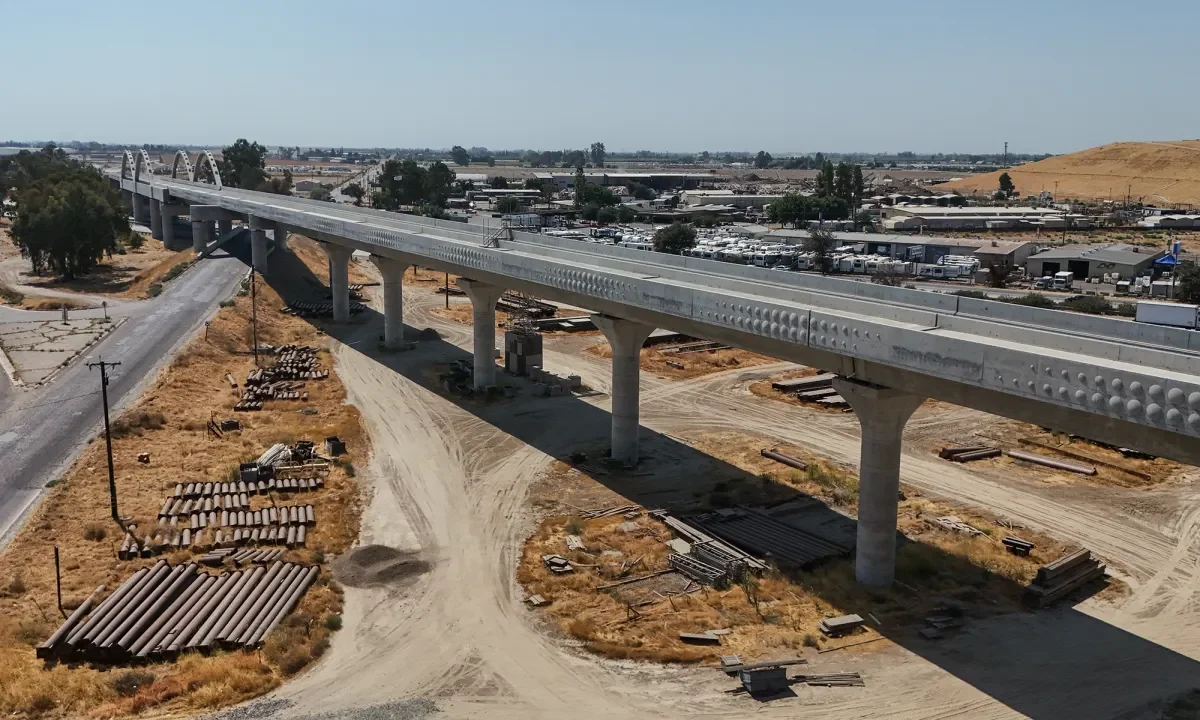
The state’s woebegone bullet train project has been receiving a quarter of auction revenues, roughly $1 billion a year. But in the new version it will be guaranteed a flat $1 billion a year to keep it alive — barely — as state officials try to scare up the many billions of dollars more needed for the bullet train to become a reality.
While supporters ballyhoo the bullet train as something that would have a major impact on emissions by reducing auto traffic, the High Speed Rail Authority’s own projections indicate that, were it to be fully completed, it would reduce automobile emissions by scarcely 1%. Meanwhile construction actually increases emissions.
$1 Billion for Whatever Lawmakers Want
At Newsom’s behest, the revised program will also channel $1.25 billion into supporting wildfire suppression, thereby relieving pressure on the state’s deficit-ridden budget.
Legislators, in turn, have set aside another $1 billion as “discretionary” spending — meaning it can be spent on anything legislative leaders want.
Those three things will consume most of the money, while having minimal impact on greenhouse gas emissions.
When the Legislative Analyst’s Office was describing auction proceeds as “akin to tax revenues,” it was putting on paper something that’s been apparent for years — that cap and trade is a backdoor tax on consumers, because industrial purchasers fold auction payments into the prices of what they produce.
An obvious example is gasoline. It’s widely accepted that California’s gas prices, the highest in the nation, include about 30 cents a gallon in cap-and-trade costs incurred by refiners. That $4 billion annual hit on motorists, moreover, is not being spent on improving roadways, but on a bunch of other things politicians fancy.
This article was originally published on CalMatters and was republished under the Creative Commons Attribution-NonCommercial-NoDerivatives license.