|
Getting your Trinity Audio player ready...
|
If the state can’t enforce how many sex offenders may live in a single home, Fresno County says it will.
Supervisors Garry Bredefeld and Brian Pacheco are introducing an ordinance Tuesday that would limit any single-family home housing sex offenders to six beds.
Sex offenders are allowed to live in residential neighborhoods, and Bredefeld said the county’s “hands are tied.”

The supervisors are interpreting state law that limits how many sex offenders that can live in a single home to six total (including non-sex offenders). There are exemptions for living with relatives.
The new ordinance, supervisors said, would give the county teeth to enforce the law when the state has not.
The Fresno County Sheriff’s Office said some facilities were found with as many as 16 people living in a single home.
Fines and Jail
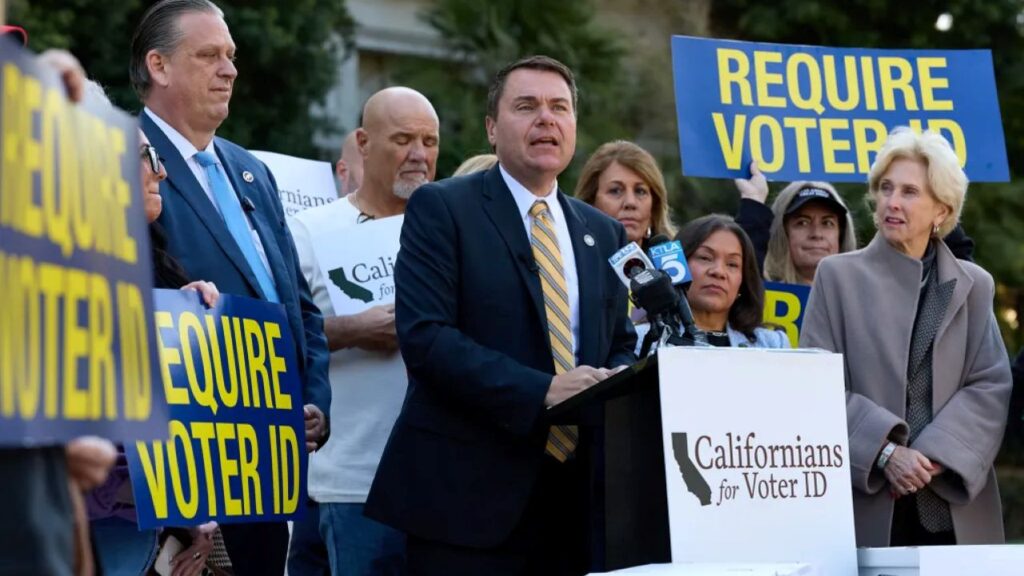
A frustrated Bredefeld and Pacheco previewed their legislation at a Monday morning news conference at the Hall of Records.
“We’re not messing around,” Bredefeld said. “This ordinance has one purpose — to protect families, restore safety, and ensure a high quality of life for our communities in Fresno County.”
Portions of a law restricting offenders from living near schools and other sensitive locations were struck down by the courts.
The county ordinance would levy fines on operators of $10,000 for the first offense, $20,000 for the second, and $50,000 for each violation thereafter.
Violators could also face a misdemeanor charge, punishable by up to six months in jail.
“An overconcentration of probationers and parolees with backgrounds like these has an even greater impact on our smaller rural communities,” Pacheco said.
Bredefeld and Pacheco said they were responding to constituent complaints about transitional homes housing sex offenders in their neighborhoods.
“It was our neighborhood’s number one concern,” said Frances Morrison, a Fig Garden resident and elected member of the Fig Garden Police Protection District. “Nobody wants to live with these people.”
Another resident, Beverly Raine, said living in the same neighborhood is “literally hell.”
Focus on One Operator
The supervisors listed six residences in unincorporated Fresno County they said were operated by Centers for Living — a Fresno-based company that says it is “providing a safe, sober and empowering housing environment for people who are displaced.”
Because the company does not provide treatment, it is not regulated by the state, the Sheriff’s Office said.
Fresno County Counsel Douglas Sloan said the county could regulate the homes under zoning laws.
The county also said that the Penal Code bars registrants from living in the same single-family dwelling unless they are related, but exempts “a residential facility that serves six or fewer people.”
Housing Group CEO Labels Proposal ‘Political Grandstanding’
John Coyle, CEO of the housing group, called the county’s action “political grandstanding.”
He said his group has operated for seven years, “providing faith-based housing for more than 1,200 adults without a single occupancy or parole-related violation, and the proposed ordinance simply duplicates regulations already enforced by Fresno County Parole, with whom we remain fully compliant.”
“It is unfortunate that newer, less experienced elected officials publicly described our ministry inaccurately, because when statements made in authority are not grounded in fact, fear fills the gap, and public safety is not served. Our structured homes provide curfews, accountability, and support — offering stability for individuals who might otherwise be homeless or unsupervised — and this model has produced some of the lowest recidivism outcomes in Fresno County’s transitional housing history,” Coyle said.
On its website, CFL says it charges $20 a day.
Property records list CFL as the owner of two adjacent homes in the Fig Garden neighborhood. One has six registrants and the other has three, according to the Megan’s Law website.
At a location outside Kerman, six offenders are registered at a home.
Other locations — where records list owners other than CFL — show three offenders living in each home.
Sheriff: Strain on Resources
Fresno County Sheriff John Zanoni said responding to transitional homes with multiple sex offenders strains department resources.
“When we go out to some of these residences, especially within the county, and there are 12 to 16 people there, it takes a lot of resources and a lot of our time. And these are not the kinds of calls we should be handling in residential neighborhoods,” Zanoni said.
Last August, a woman allegedly entered one of the homes in the Fig Garden neighborhood and shot a resident she accused of violating her daughter. She was taken into custody.
“It is just not acceptable. This ordinance enhances public safety and will improve the quality of life for residents throughout Fresno County,” Zanoni said.
Bredefeld: No Rehabilitating
Bredefeld, a retired psychologist, said there is no rehabilitating sex offenders.
“They ought to be on an island somewhere. Or, frankly, they belong in jail and shouldn’t be released — and certainly shouldn’t be released into neighborhoods with families,” Bredefeld said.
“Pedophiles don’t change. I can tell you that from my profession,” Bredefeld said. “You cannot change them.”