|
Getting your Trinity Audio player ready...
|
The holiday season in the Kaweah subbasin got a little more jolly thanks to its formal removal from the state’s groundwater enforcement process on Tuesday.

Lisa McEwen
SJV Water
The state Water Resources Control Board passed a resolution at its Dec. 2 meeting that officially ended the threat of state intervention for the Kaweah subbasin, which covers the northern part of Tulare County’s flatlands and a portion of Kings County.
It will continue to work under Department of Water Resources oversight to implement plans to reduce excessive groundwater pumping.

The move frees landowners from costly probationary fees under the Sustainable Groundwater Management Act (SGMA), which also comes with well metering and reporting requirements.
If Kaweah had not escaped probation, landowners would be forced to reveal pumping records, and pay $20 per acre-foot of water pumped while registering wells at $300 each, on top of what they already pay to their irrigation districts and groundwater sustainability agencies.
Kaweah Sets the Bar for Sustainability
In a lighthearted 45-minute session, state board staff and board members all repeated one theme: Kaweah’s management team has set an example for other subbasins to follow.
“They set the bar ultimately when it comes to groundwater sustainability plans and importantly, in approach with communities and us as regulators,” said board chairman E. Joaquin Esquivel.
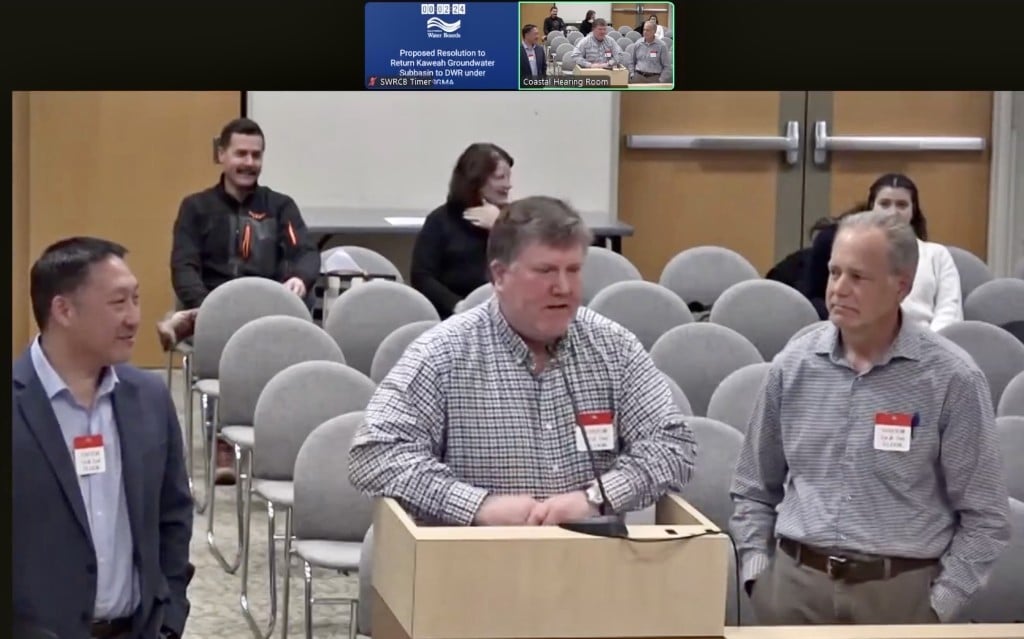
Managers Mike Hagman of East Kaweah GSA, Aaron Fukuda of Mid-Kaweah GSA and Mark Larsen of Greater Kaweah GSA briefly addressed the board before the vote, offering thanks for the collegial tone of their work with state board staff over the course of 19 technical meetings in the past two years.
“We’re celebrating leaving probation but I don’t want that to be an indicator of our impression of you as the board and your staff,” said Fukuda. “We really appreciated the collaboration and getting to the finish line was all about getting in the trenches together. Our landowners and businesses are going to benefit from that.”
Fukuda was referring to the fact that the three Kaweah groundwater sustainability agencies collectively took a hard line on pumping allocations, protection of domestic wells and groundwater quality, while allowing zero subsidence near the Friant-Kern Canal.
But he also acknowledged the difficult work ahead for the GSAs, something echoed to landowners during a State of the Basin event last month in Tulare.
“We had to make difficult decisions in those (groundwater sustainability plans) and now our job becomes real,” Fukuda said.
While some have said SGMA is 30 or 40 years late, Esquivel said the work done today will benefit future generations.
“It’s here for the benefit of those future generations that won’t have to have as hard of a row in getting at least a plan and infrastructure in place to better manage our groundwater,” he said.
Culture of Collaboration
Tien Tran, policy manager at Community Water Center, said Kaweah’s culture of collaboration was on display at her first meeting with East Kaweah’s Hagman regarding a domestic well mitigation program.
“It helped me think through, ‘Okay, how can I work together in this subbasin to make sure that impacted communities have their drinking water protected while also considering all other beneficial users and uses?” Tran said.
She called Kaweah’s partnership with Self-Help Enterprises on supplying interim and long-term water supply to households “monumental to the communities who have been left behind.”
Kaweah is the third San Joaquin Valley basin, along with Chowchilla and Kern, to return to the Department of Water Resources.
Two San Joaquin Valley subbasins remain on probation, Tule and Tulare Lake. The groundwater management plans of the Delta-Mendota and Pleasant Valley subbasins were deemed inadequate and they remain in the state intervention process.
About the Reporter
SJV Water Reporter Lisa McEwen grew up in Tulare County. She has reported on agriculture and other issues for a wide variety of publications, including, Ag Alert, Visalia Times-Delta, the Fresno Bee and the Tulare and Kings counties farm bureau publications.
About SJV Water
SJV Water is an independent, nonprofit news site covering water in the San Joaquin Valley, www.sjvwater.org. Email us at sjvwater@sjvwater.org