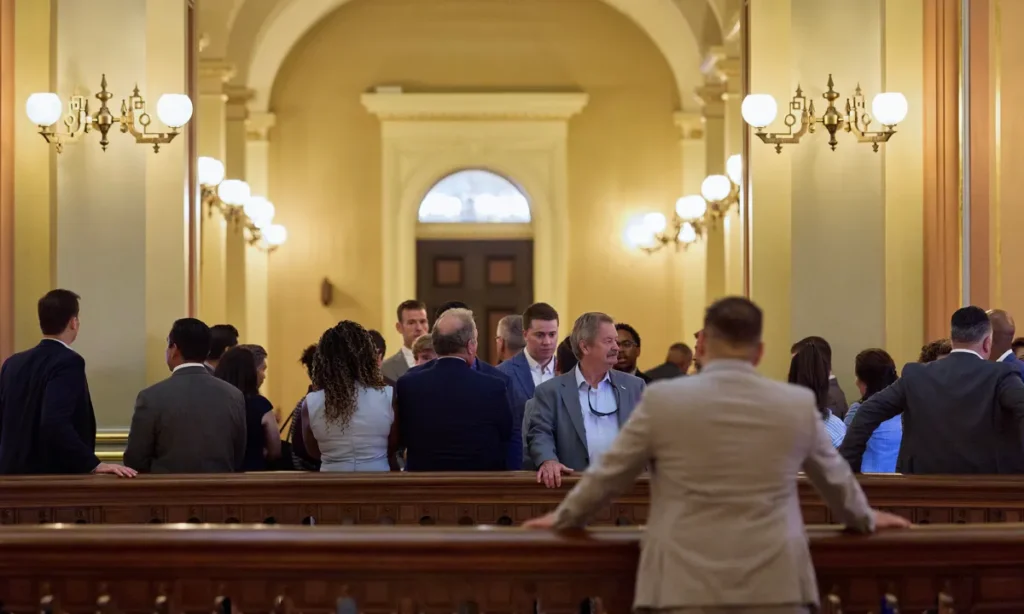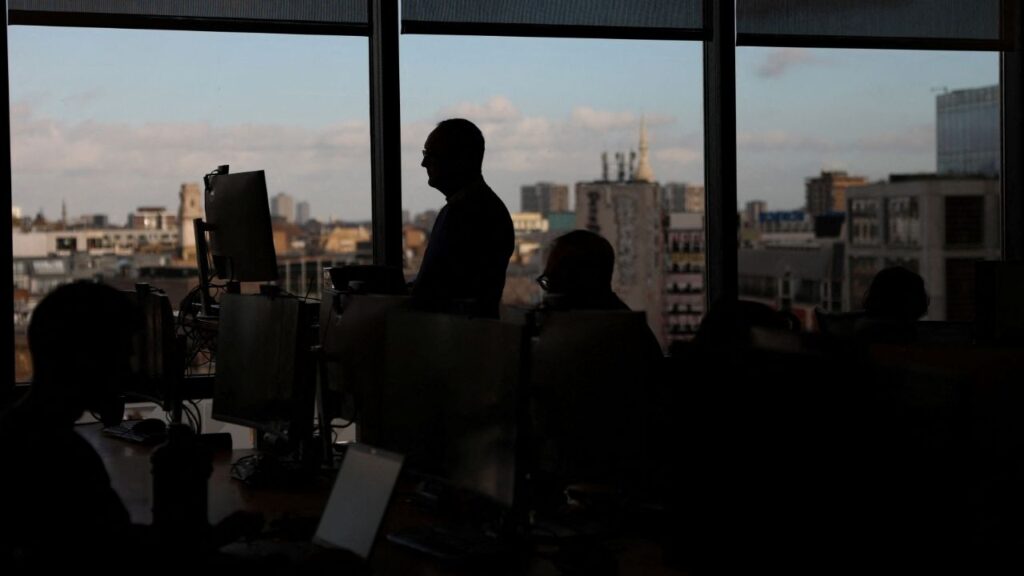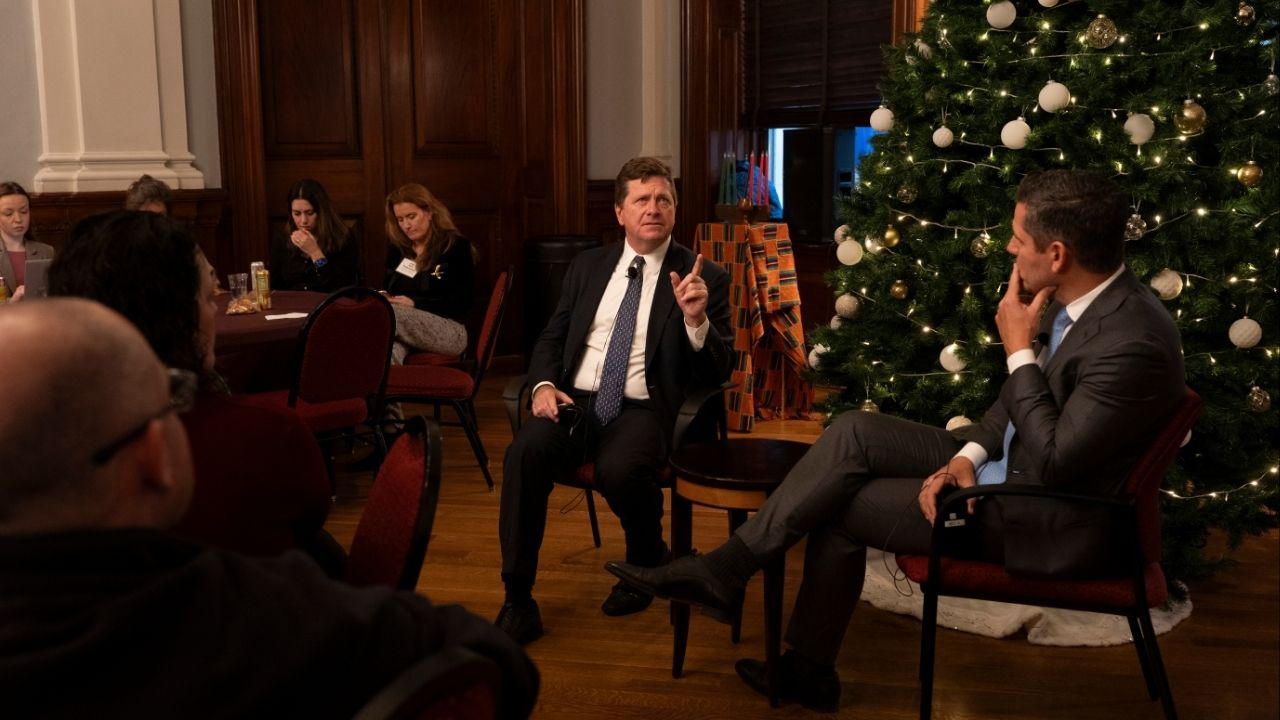
Jay Clayton, U.S. attorney for the Southern District of New York, speaks to the New York City bar association on Tuesday, Dec. 2, 2025. Clayton had hailed his office’s prosecution of an ex-president of Honduras for narcotics trafficking a success. Here, he faced questions over President Donald Trump’s decision to pardon Juan Orlando Hernández. (James Estrin/The New York Times)

Share
|
Getting your Trinity Audio player ready...
|
NEW YORK — A packed room of lawyers gathered Tuesday at the city’s bar association in midtown Manhattan to hear Jay Clayton, the U.S. attorney for the Southern District of New York, be interviewed about the job he has held since President Donald Trump appointed him in April.
Clayton’s appearance — his first of two Tuesday — was the highlight of a symposium on international white-collar crime. But when his interviewer opened up questions to the audience, things got tricky: One person asked about Trump’s pardon Monday of Juan Orlando Hernández, the former president of Honduras, who was convicted in a landmark narcotics trafficking case in 2024 by the Southern District.
Clayton did not have to answer.
His interviewer, James M. McDonald, a former law partner, interjected, noting Clayton could not comment on particular cases, and he suggested a way to perhaps “rephrase the question.”
Soon Clayton was talking about charges against 19 people accused of running an open-air drug market in Washington Square Park. The park had been clean for six weeks, he said, adding that it was “something that I think we should be proud of.”
Clayton’s appearances Tuesday were scheduled long before this fraught political moment. They came the day after the pardon and weeks after Attorney General Pam Bondi announced that she had chosen Clayton to lead an investigation into ties between Jeffrey Epstein and prominent Democrats, which Trump had demanded just hours earlier in a social media post.
Bondi called Clayton “one of the most capable and trusted prosecutors in the country,” but the assignment — about which he was not asked in his appearances Tuesday — plunged him and his agency into an ethical morass, given that the Justice Department in July said in a memo that there was no incriminating “client list” or evidence to support an investigation into others who had not been charged.
Pardon Undoes Years of Work
And this week, the Hernández pardon undid years of work by prosecutors who still serve under him in a U.S. attorney’s office that was once fiercely independent and unrivaled in prestige.
Hernández, who had been serving a 45-year sentence, was convicted of conspiring to import cocaine to the United States. His lawyer said Tuesday that Hernández had been released from a federal prison in West Virginia.
Clayton has not hesitated in recent months to talk about his goal of putting drug lords out of business.
“We should bankrupt the cartels,” he said in September on CNBC’s “Squawk Box.”
“They may as well be a Fortune 100 company,” he continued. “Their sophistication, their distribution networks. And they do not care about people.”
And in a luncheon speech to the Police Athletic League, Clayton said his office and its partners have been “steadfast in our fight against the world’s most violent and prolific drug trafficking entities,” according to his prepared remarks, which were posted on the Southern District’s website.
Clayton, in the remarks, cited examples of some of “our most recent efforts” in that fight, among them “the successful prosecution” of Hernández and other high-level Honduran officials for narcotics trafficking and firearms charges and “for partnering with some of the largest and most violent cartels in the world to distribute tons of cocaine to the United States.”
Later Tuesday, in his second public appearance, an event presented by the news organization Semafor, Clayton sat for a wide-ranging interview that included a question about pardons, this time more generally. The interviewer, Liz Hoffman, a Semafor editor, cited several pardons of defendants by Trump in major financial cases in the Southern District and elsewhere.
“You get a conviction, you cheer your line prosecutors on, and then they get pardoned,” Hoffman asked. “How do you think about that?”
“I’m not going to comment on any specific cases; it’s just not appropriate,” Clayton replied.
But he made it clear that he understood with a pardon, “the president has the final word.”
—
This article originally appeared in The New York Times.
By Benjamin Weiser/James Estrin
c. 2025 The New York Times Company
RELATED TOPICS:
Categories

Sling Goes Down for Thousands of User, Downdetector Reports